Title: Anyone know about NextStep on AIX?
Post by: protocol7 on April 28, 2011, 01:14:31 PM
Post by: protocol7 on April 28, 2011, 01:14:31 PM
I only heard about this recently and a quick search for AIX here drew a blank. From what I've gathered it took so long for the 1.0-based NextStep to show up on AIX that NeXT had already released 2.0, so it ended up being a short-lived venture. I don't know for sure if it even shipped.
There's a usenet posting here (http://newsgroups.derkeiler.com/Archive/Comp/comp.sys.ibm.ps2.hardware/2007-04/msg00369.html) of the press release. For posterity I'll paste a copy here too.
There's a usenet posting here (http://newsgroups.derkeiler.com/Archive/Comp/comp.sys.ibm.ps2.hardware/2007-04/msg00369.html) of the press release. For posterity I'll paste a copy here too.
QuoteIBM Announcement Letter Number 290-171 dated March 27, 1990
Brief Description of Announcement, Charges, and Availability
AIX (R) PS/2 (R) NextStep (1) Environment Version 1.1 is a
state-of-the-art graphical user interface and programming environment
for AIX workstations, designed to be compatible with the same
application programming interface (API) as the NextStep product,
Software Release 1.0, provided by NeXT (2), Incorporated. (NOTE:
AIX PS/2 NextStep Environment Version 1.1 is marketed as AIX PS/2
Graphic User Environment Version 1.1 in some other countries.)
AIX PS/2 NextStep Environment Version 1.1 provides icons and
menus to facilitate access to system utilities and applications. The
AIX NextStep Interface Builder (1) is designed to provide a rich set
of well-defined objects and graphical cut-and-paste capabilities for
designing and implementing application user interfaces. The
Objective-C (3) Compiler provides the benefits of object-oriented
programming for developers who choose to design additional objects
for the application development environment. AIX PS/2 NextStep
Environment can help increase the productivity of programmers and end
users.
PROGRAM
NAME/ ONE-TIME
NUMBER CHARGE
AIX PS/2 NextStep
Environment Version 1.1
(5601-395) $ 500
Planned Availability Date: September 28, 1990
(R) Registered trademark of International Business Machines
Corporation.
(1) Trademark of NeXT, Inc.
(2) Registered trademark of NeXT, Incorporated.
(3) Trademark of Stepstone Corporation.
Customer Letter Section
HIGHLIGHTS
o State-of-the-art graphical user interface and programming
environment
o A Window Server
o Display PostScript (4) Interpreter
o Workspace management tool
o Full use of screen and control of multiple applications
o Objective-C capability to design additional objects for the
application development environment
o Cut-and-Paste capabilities for designing and implementing
application user interfaces
o Client/Server model for distributed windows using PostScript
protocol.
(4) Registered trademark of Adobe Systems, Inc.
DESCRIPTION
USER PRODUCTIVITY: AIX PS/2 NextStep Environment Version 1.1 for IBM
PS/2 models using the AIX Operating System Version 1.2, is a
state-of-the-art graphical user interface for IBM AIX workstations,
designed to be compatible with the same application programming
interface (API) as the NextStep product provided by NeXT,
Incorporated.
The AIX PS/2 NextStep Environment Version 1.1 facilitates
access to system utilities and applications through tear-off menus
and icons with a high-quality, 3D appearance.
The AIX PS/2 NextStep Environment Version 1.1 consists of the
following:
WINDOW SERVER: A process that manages AIX PS/2 NextStep windows,
drawing images on the display according to instructions sent from an
application, and sending user actions, such as pressing a mouse
button or typing on the keyboard, back to an application.
The window server uses the Display PostScript Interpreter to
draw all text and graphics on the screen or printed page. The
Display PostScript Interpreter provides an interactive,
display-oriented environment that is independent of the window
system. In addition, it provides a single-image model for both
display and printer data streams.
DESKTOP WORKSPACE: An application that runs automatically after a
user starts up AIX PS/2 NextStep. From the desktop workspace, a user
can start applications, manage files (for example, create, open,
delete or modify), move about the AIX file system with a file browser
application and perform other tasks.
INTERFACE BUILDER: An application that displays a window
representing a program's user interface and provides graphical access
to a number of standard interface objects, such as text fields,
buttons, menus and windows. (An object is a programming unit that
associates data with the particular operations that can use or affect
that data.) To design an interface, a programmer simply moves
interface objects into the program window, strategically placing them
and giving them the characteristics desired.
In addition, the programmer does not have to write additional
code to perform basic display operations and handle common user
events. The interface objects are already coded to understand user
events, such as mouse and keyboard actions, and automatically perform
basic display operations when an action is directed at them. For
example, a button knows how to graphically highlight itself when a
user selects it; a text field displays characters that the user types
in; a window disappears when its "close" button is selected.
The Interface Builder also has tools for connecting interface
objects to each other. For instance, a programmer can connect a
button to a panel so the panel comes to the front when the user
selects the button, or connect a slider to a text field so the value
displayed in the text field is continuously updated as the user moves
the slider. For some simple applications, the interface objects and
the code provided by the AIX NextStep application development
environment are sufficient to allow a user to create a program
without writing a line of code. Users can also design their own
interface object and connect them in the Interface Builder.
STEPSTONE OBJECTIVE-C COMPILER: A compiler for object-oriented
programs. Objective-C is an extension of the C language.
PUBLICATIONS
The following publications are shipped as documentation with
the AIX PS/2 NextStep Environment program:
ORDER
TITLE NUMBER
AIX PS/2 NextStep Environment
User's Guide SC23-2213
AIX PS/2 NextStep Environment
Technical Concepts SC23-2217
AIX PS/2 NextStep Environment
Technical Reference SC23-2220
AIX PS/2 NextStep Environment
Technical Appendices SC23-2265
Additional copies of these publications will be available from
Mechanicsburg immediately after general availability.
EDUCATION SUPPORT
A description of these self-study and classroom courses is
contained in the catalog of IBM Education (G320-1244). Call IBM
Direct Education, 1-800-IBM-2468, for schedules, enrollments and to
place orders for self-study courses.
SCHEDULE
Availability is planned for September 28, 1990.
TECHNICAL INFORMATION
SPECIFIED OPERATING ENVIRONMENT
MACHINE REQUIREMENTS: AIX PS/2 NextStep Environment Version 1.1 is
designed to execute on the following IBM PS/2 models with minimum
configurations, as follows:
Minimum configuration for the run time environment (Window
Server and Desktop Workspace):
o 8MB memory
o Minimum 115MB fixed disk storage
o 80387 Math Co-Processor
o Mouse.
Support for IBM PS/2 models:
o PS/2 Model 8570-121
o PS/2 Model 8570-A21
o PS/2 Model 8580-071
o PS/2 Model 8580-111
o PS/2 Model 8580-311
o PS/2 Model 8580-121
o PS/2 Model 8580-321
o PS/2 Model 8580-A21
o PS/2 Model 8580-A31
o IBM 7561 Industrial Computer Model 111
o IBM 7562 Industrial Computer Model 111.
NOTE: The IBM 7561 Industrial Computer Model 111 requires RPQ
PF 1175 to increase the fixed disk storage from 60MB to 120MB. The
IBM 7562 Industrial Computer Model 111 requires RPQ PF 1178 to
increase the fixed disk storage from 60MB to 120MB.
Support for the following display:
o IBM 5081 Color (Grayscale) Display Models 011 (Graphics), 016 or
019.
Support for the following adapters:
o Matrox 8-bit Color Adapter 1280 x 1024 Model PG2-1281 (5)
o IBM Token-Ring Network Adapter/A or Ungermann Bass NICps/2
Adapter 1542 (6) (optional).
Support for the following printer:
o IBM LaserPrinter 4019 Model 1 (in postscript mode only).
Minimum configuration for the application development
environment (Window Server, Desktop Workspace, Interface Builder and
Objective-C Compiler):
o 8MB memory
o Minimum 185MB fixed disk storage
o 80387 Math Co-Processor
o Mouse.
Support for IBM PS/2 models:
o PS/2 Model 8580-071
o PS/2 Model 8580-111
o PS/2 Model 8580-311
o PS/2 Model 8580-121
o PS/2 Model 8580-321
o PS/2 Model 8580-A21
o PS/2 Model 8580-A31.
Support for the following display:
o IBM 5081 Color (Grayscale) Display Models 011 (Graphics), 016 or
019.
Support for the following adapters:
o Matrox 8-bit Color Adapter 1280 x 1024 Model PG2-1281
o IBM Token-Ring Network Adapter/A or Ungermann Bass NICps/2
Adapter 1542 (optional).
(5) Registered Trademark of Matrox Electronic Systems Ltd.
(6) Although this device can be ordered from IBM, this adapter is
not an IBM product. Other commercially available adapters and
associated device drivers may provide an alternative solution.
Support for the following printer:
o IBM LaserPrinter 4019 Model 1 (in postscript mode only).
PROGRAMMING REQUIREMENTS: AIX PS/2 NextStep Environment Version 1.1
is designed to execute under IBM AIX PS/2 and requires the following
software support.
For AIX PS/2 NextStep Environment:
o AIX PS/2 Operating System (5713-AEQ) Version 1.2.
For AIX NextStep Application Development Environment:
o AIX PS/2 Operating System (5713-AEQ) Version 1.2
o AIX PS/2 C Language (5713-AFC)
o AIX PS/2 Application Development Toolkit (5713-AEP).
LIMITATIONS: The AIX PS/2 NextStep Environment Version 1.1 supports
a single-user only, will be licensed for use by one user on one
machine at any one time, and may only be executed on the graphics
console. PS/2 VGA and 8514 displays are not supported. (Refer to
the MACHINE REQUIREMENTS section for a listing of supported
displays).
NOTE: This release of AIX PS/2 NextStep Environment for AIX
Version 1.2 does not provide hardware or National Language
application program support. Additionally, machine memory is limited
to a maximum of 11MB.
PERFORMANCE CONSIDERATIONS: Performance may be affected by the total
system memory available, the amount of fixed disk storage available
and type/performance of disk drives.
PLANNING INFORMATION
CUSTOMER RESPONSIBILITIES: The customer is responsible for
installing these programs. Additionally, the customer is responsible
for acquiring all prerequisite software and hardware associated with
this product.
PACKAGING: AIX PS/2 NextStep Environment is distributed with the
following materials:
o License Information
o Program Support Summary
o AIX PS/2 NextStep Environment User's Guide
o AIX PS/2 NextStep Environment Technical Concepts
o AIX PS/2 NextStep Environment Technical Reference
o AIX PS/2 NextStep Environment Technical Appendices
o Nine 3.5-inch High Density (1.44MB) diskettes
o Diskette Holder
o Diskette Jacket
o Program Support Summary Envelope
o Bar Code Label.
SECURITY, AUDITABILITY AND CONTROL
The AIX NextStep program uses the security and auditability
features of AIX PS/2 Operating System.
User management is responsible for evaluation, selection and
implementation of security features, administrative procedures and
appropriate controls in application systems and communication
facilities.
ORDERING INFORMATION
Ordering instructions will be provided when the program
becomes available.
TERMS AND CONDITIONS
LICENSING: AIX PS/2 NextStep Environment is licensed under the terms
and conditions of the IBM Program License Agreement -- Extended
Provisions.
ADDITIONAL LICENSE: EP/PLA must be in effect.
LIMITED WARRANTY: Program: Yes. Media: Three months.
Additional Licenses: Yes. Media: Not applicable.
PROGRAM SERVICES: Central service, including the IBM Support Center,
will be available until December 31, 1991, or until discontinued by
IBM upon six months written notice, whichever is earlier. The
statement of service included in the program package describes this
service.
VOLUME DISCOUNT: Volume discounting is available under the terms and
conditions of the Volume Procurement Amendment (VPA) for Machines and
Programs and the Exhibit for IBM AIX for RISC System/6000 Licensed
Programs. Program packages and additional licenses are included in
Category C and are eligible for a maximum 30% discount at a quantity
of 40.
TESTING PERIOD: Two months for up to three licenses of a program and
the EP/PLA must be in effect.
NATIONAL EDUCATION LICENSE FEE: A National Education License Fee
(NELF) is available under the terms and conditions of the National
Education License Fee Exhibit. The NELF, which represents a 33%
discount off the single unit price, is not subject to any further
discount or allowance.
CHARGES
PROGRAM ONE-TIME
NAME/NUMBER ORDER TYPE CHARGE
AIX PS/2
NextStep Environment
5601-395 Program Package $ 500
Additional Licenses 450
ONE-TIME CHARGE: Customers who pay a one-time charge for a licensed
program receive enhancements and future releases, if any, at no
additional charge. Significant new function may be offered as an
optional feature, and charged for separately. If a new version is
announced and the customer elects to license the new version for a
one-time charge and replace the prior version, an upgrade charge may
apply.
ADDITIONAL LICENSES CHARGE: Customers who pay a one-time charge for
additional licenses may copy machine readable program materials and
printed documentation previously acquired from IBM in a program
package. One copy may be made for each additional license ordered.
Title: More USENET lore
Post by: itomato on November 08, 2013, 09:35:43 AM
Post by: itomato on November 08, 2013, 09:35:43 AM
https://groups.google.com/forum/#!topic/comp.sys.next.advocacy/LlZ-loUmDVk
there are a few shreds in the opensource codebase: http://www.opensource.apple.com/source/gcc/gcc-937.2/gcc/config/rs6000/macosx.h
there are a few shreds in the opensource codebase: http://www.opensource.apple.com/source/gcc/gcc-937.2/gcc/config/rs6000/macosx.h
Title: Anyone know about NextStep on AIX?
Post by: protocol7 on November 08, 2013, 10:21:24 AM
Post by: protocol7 on November 08, 2013, 10:21:24 AM
Wow. Getting that email alert 2.5 years later was a surprise!
Thanks for the link. Interesting reading :)
Thanks for the link. Interesting reading :)
Title: Re: Anyone know about NextStep on AIX?
Post by: K-Town Computeum on December 08, 2022, 06:30:56 AM
Post by: K-Town Computeum on December 08, 2022, 06:30:56 AM
When picking up a SUN workstation from a seller recently, he showed me a manual titled 'IBM AIX NextStep Environment/6000; SC23-2357'. Unfortunately he didn't want to sell this manual to me but I took a few picture of the first pages/table of contents.
Here's an excerpt from the 'About this book' section
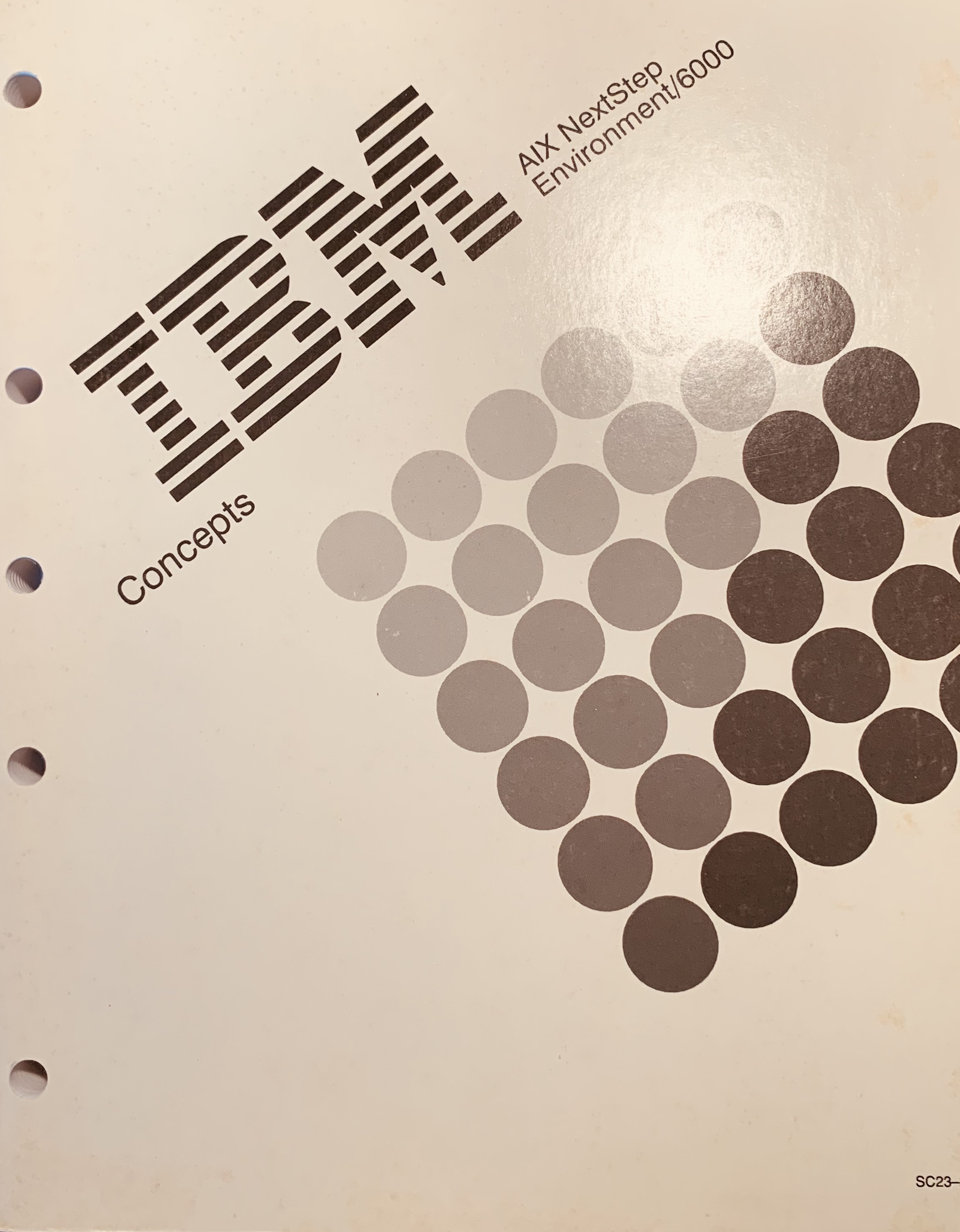
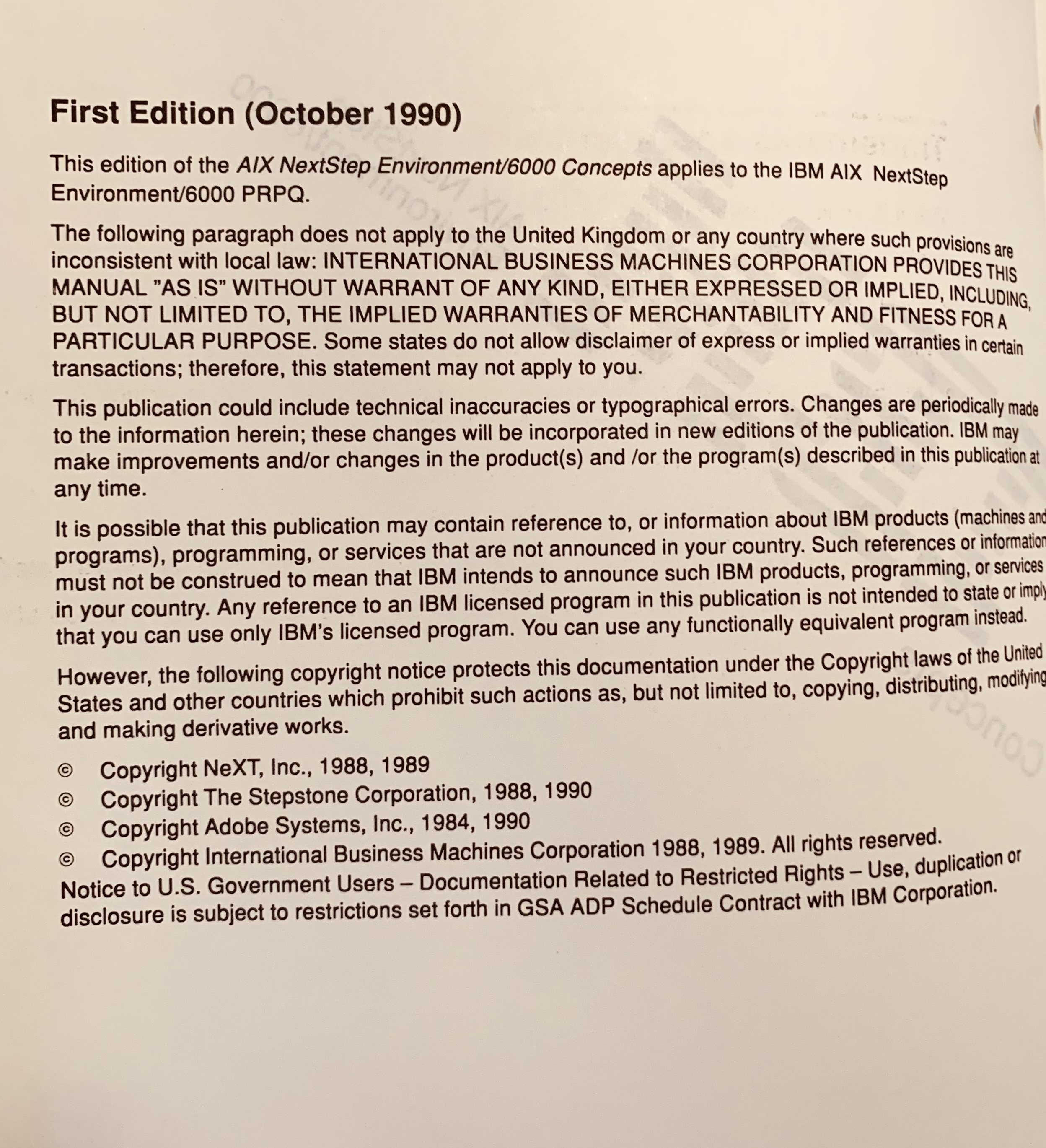
Does anybody of you have a full copy of this book ('AIX NextStep Environment/6000', SC23-2357), and/or of these two other ones:
And even more important: does anybody of you have installation media for this AIX NextStep Environment/6000 to install and run it on actual RS/6000 HW?
Here's an excerpt from the 'About this book' section
Code Select
About This Book
The AIX NextStep Environment/6000 Concepts provides detailed information for the programmer
writing NextStep applications for the RISC System/6000. The AIX NextStep
Environment/6000 is also known in some countries as AIX Graphic User Environment/6000.

Who Should Use This Book
This manual is designed for the programmer who wants to write NextStep applications
for the RISC System/6000. Programmers interested in AIX and other system software should
also see and the AIX manuals listed in the "Related Publications" sections below.
Some topics are not covered here in detail. Instead, you are referred to a generally
available book on the subject. See "Related Information" on page vi.
For many programmers, only a fraction of the information in this manual will have to be
learned; the more sophisticated the application, the more you will need to understand.
This manual assumes you are familiar with the standard NextStep user interface. Some
experience using a NextStep application, such as Edit, would be helpful.

How This Book is Organized
This book is divided into twelve chapters that provide a conceptual framework
for the detailed information provided in the AX NextStep Environment/6000 Technical
Reference. It gives a high-level view of each component of the system software,
explaining how that component is used and how it fits in with the rest of the software.

The twelve chapters are:
• Chapter 1. NextStep Environment System Overview
• Chapter 2. NextStep Environment User Interface Overview
• Chapter 3. NextStep Environment Object-Oriented Programming and Objective C Overview
• Chapter 4. NextStep Environment Drawing Overview
• Chapter 5. NextStep Environment Events Overview
• ...
Does anybody of you have a full copy of this book ('AIX NextStep Environment/6000', SC23-2357), and/or of these two other ones:
- AIX NextStep Environment/6000 Users Guide, SC23-2356
- AIX NextStep Environment/6000 Technical Reference, SC23-2358
And even more important: does anybody of you have installation media for this AIX NextStep Environment/6000 to install and run it on actual RS/6000 HW?
Title: Re: Anyone know about NextStep on AIX?
Post by: cuby on December 08, 2022, 07:30:52 AM
Post by: cuby on December 08, 2022, 07:30:52 AM
The link to the original usenet post no longer works, but it can still be found on archive.org):
https://web.archive.org/web/20170206141810/http://newsgroups.derkeiler.com/Archive/Comp/comp.sys.ibm.ps2.hardware/2007-04/msg00369.html (https://web.archive.org/web/20170206141810/http://newsgroups.derkeiler.com/Archive/Comp/comp.sys.ibm.ps2.hardware/2007-04/msg00369.html)
https://web.archive.org/web/20170206141810/http://newsgroups.derkeiler.com/Archive/Comp/comp.sys.ibm.ps2.hardware/2007-04/msg00369.html (https://web.archive.org/web/20170206141810/http://newsgroups.derkeiler.com/Archive/Comp/comp.sys.ibm.ps2.hardware/2007-04/msg00369.html)
Title: Re: Anyone know about NextStep on AIX?
Post by: Rob Blessin Black Hole on December 08, 2022, 10:49:01 PM
Post by: Rob Blessin Black Hole on December 08, 2022, 10:49:01 PM
I had to splitthe following article into multiple parts as there is a 10,000 character limit per post , I use frogfind.com to bypass the pesky subscription pop up and remove ad's and it works even in old webbrowsers :) Enjoy , Thank you Fortune magazine 1989 :)
How Steve Jobs Linked Up With IBM
View page images: [1]
Step back in time to 1984—an eon ago in the personal computer industry. Steve Jobs, then 29, was chairman of Apple (AAPL) Computer and still a good friend of John Sculley, his hand-picked CEO. That year the two launched a cute little machine called the Macintosh with an instantly famous television commercial bashing Apple's archrival IBM (IBM) as a monolithic, sinister Big Brother.
Fast-forward to the present. Cast out of Apple in 1985 by Sculley, Jobs started a new company, Next Inc., that was finally to begin shipping his latest creation in mid-September. Jobs claims that the Next computer, a starkly elegant black cube with a powerful array of up-to-the-minute goodies, could transform the PC business as thoroughly as the Macintosh has.
Guess who is Jobs's biggest believer this time? None other than Big Bad Blue. IBM was so impressed by Next's distinctive software and three-dimensional look on the screen that it agreed to pay tens of millions for the right to offer them on a new line of high-powered computer workstations that it will introduce in a few months. In effect IBM could be selling Next clones, although Big Blue—more cloned against than cloning—would cringe at the term.
And guess who this new alliance between old adversaries leaves on the sidelines? None other than boyish billionaire Bill Gates, founder of Microsoft Corp. (MSFT) and chief architect of IBM's original PC software. Gates, eight months Jobs's junior, has been the other Wunderkind of the personal computer industry. Seven years ago, despite his strategic relationship with IBM, he was so taken by the graphics and simplicity of the proposed Macintosh that he set up a new group to write crucial programs for the machine. He and Jobs talked regularly by phone. With the Macintosh, Apple came close to displacing Big Blue as the top seller of PCs. Microsoft became the dominant maker of Macintosh software, ringing up hundreds of millions of dollars of program sales for Jobs's pride and joy.
As Gates did earlier, IBM has embraced Jobs's latest technology even though it does not fit its grand software strategy for PCs. What's going on here? "A funny thing has happened since we started working with IBM," says Jobs, who revels in the paradox of his new partnership. "We like them and they like us." And where is Bill Gates? Alone among the top PC software makers, Microsoft has opted not to develop programs for the Next computer.
"The Macintosh was truly unique, but I personally don't understand what is so unique about Steve's new computer," Gates says. He points out, for example, that Next cannot produce color video images but must make do with prosaic black and white. (Jobs pleads pressures of time and cost; he promises color "soon"—most likely in 1990.) Besides, Gates adds, Microsoft has more important things to work on—namely OS/2, the next generation operating system software for IBM PS/2 desktops. Jobs, who calls OS/2 "yesterday's oatmeal," of course sees it differently. "Bill has placed a very risky bet," he says. "If he's right and we fail, it will be a small feather in his cap. But if he's wrong, it will be a lost opportunity that will be hard for Microsoft to recover from."
The Jobs-IBM-Gates triangle is more than an internal squabble among industry titans. Its outcome will determine what workstations, the high-powered desktop computers for the Nineties, will look like, what they will do, and who will use them. "Jobs's wooing of IBM is just the opening skirmish in what has become a sordid battle for intellectual leadership of the industry," says Stewart Alsop, editor of P.C. Letter. At an upcoming conference on PCs, Alsop will distribute a poster showing Gates cheerfully strangling Jobs. Says Alsop: "While Gates appears to have the advantage, you can't count out Jobs. He is the only person in the industry who has created successful computers without IBM's help. And now IBM is on his side too."
Even before he has sold a single Next computer to the general public, Jobs is once again trying to realign and redefine the industry he helped create. Not only is he playing longstanding partners IBM and Microsoft against each other, but he is also egging on Gates's software rivals, such as Lotus Development, by reminding them that Gates's link to Apple cut them out of big chunks of business. Jobs says he wants them "to do to Microsoft with the Next computer what Microsoft did to them with the Macintosh." He intends to break the software barrier that usually holds back new computers by persuading software companies to write programs that will distinguish the machine from its competition. So far, more than 70 have signed on.
Jobs has other powerful supporters. He has lined up Businessland Inc., the premier seller of personal computers to big corporations, as Next's exclusive U.S. distributor. He has persuaded Japan's Canon Inc., which will handle distribution in Asia, to invest $100 million in the company. Those relationships came together so quickly that Next abruptly ditched its cautious original plan to start by supplying universities with "scholar's workstations." Instead Jobs is going for what he calls "the whole enchilada"—establishing a third major general-purpose desktop computer beyond the PC and the Macintosh, aimed mainly at the business market.
Microsoft co-founder Bill Gates.Photograph by Doug Menuez
How Steve Jobs Linked Up With IBM
View page images: [1]
Step back in time to 1984—an eon ago in the personal computer industry. Steve Jobs, then 29, was chairman of Apple (AAPL) Computer and still a good friend of John Sculley, his hand-picked CEO. That year the two launched a cute little machine called the Macintosh with an instantly famous television commercial bashing Apple's archrival IBM (IBM) as a monolithic, sinister Big Brother.
Fast-forward to the present. Cast out of Apple in 1985 by Sculley, Jobs started a new company, Next Inc., that was finally to begin shipping his latest creation in mid-September. Jobs claims that the Next computer, a starkly elegant black cube with a powerful array of up-to-the-minute goodies, could transform the PC business as thoroughly as the Macintosh has.
Guess who is Jobs's biggest believer this time? None other than Big Bad Blue. IBM was so impressed by Next's distinctive software and three-dimensional look on the screen that it agreed to pay tens of millions for the right to offer them on a new line of high-powered computer workstations that it will introduce in a few months. In effect IBM could be selling Next clones, although Big Blue—more cloned against than cloning—would cringe at the term.
And guess who this new alliance between old adversaries leaves on the sidelines? None other than boyish billionaire Bill Gates, founder of Microsoft Corp. (MSFT) and chief architect of IBM's original PC software. Gates, eight months Jobs's junior, has been the other Wunderkind of the personal computer industry. Seven years ago, despite his strategic relationship with IBM, he was so taken by the graphics and simplicity of the proposed Macintosh that he set up a new group to write crucial programs for the machine. He and Jobs talked regularly by phone. With the Macintosh, Apple came close to displacing Big Blue as the top seller of PCs. Microsoft became the dominant maker of Macintosh software, ringing up hundreds of millions of dollars of program sales for Jobs's pride and joy.
As Gates did earlier, IBM has embraced Jobs's latest technology even though it does not fit its grand software strategy for PCs. What's going on here? "A funny thing has happened since we started working with IBM," says Jobs, who revels in the paradox of his new partnership. "We like them and they like us." And where is Bill Gates? Alone among the top PC software makers, Microsoft has opted not to develop programs for the Next computer.
"The Macintosh was truly unique, but I personally don't understand what is so unique about Steve's new computer," Gates says. He points out, for example, that Next cannot produce color video images but must make do with prosaic black and white. (Jobs pleads pressures of time and cost; he promises color "soon"—most likely in 1990.) Besides, Gates adds, Microsoft has more important things to work on—namely OS/2, the next generation operating system software for IBM PS/2 desktops. Jobs, who calls OS/2 "yesterday's oatmeal," of course sees it differently. "Bill has placed a very risky bet," he says. "If he's right and we fail, it will be a small feather in his cap. But if he's wrong, it will be a lost opportunity that will be hard for Microsoft to recover from."
The Jobs-IBM-Gates triangle is more than an internal squabble among industry titans. Its outcome will determine what workstations, the high-powered desktop computers for the Nineties, will look like, what they will do, and who will use them. "Jobs's wooing of IBM is just the opening skirmish in what has become a sordid battle for intellectual leadership of the industry," says Stewart Alsop, editor of P.C. Letter. At an upcoming conference on PCs, Alsop will distribute a poster showing Gates cheerfully strangling Jobs. Says Alsop: "While Gates appears to have the advantage, you can't count out Jobs. He is the only person in the industry who has created successful computers without IBM's help. And now IBM is on his side too."
Even before he has sold a single Next computer to the general public, Jobs is once again trying to realign and redefine the industry he helped create. Not only is he playing longstanding partners IBM and Microsoft against each other, but he is also egging on Gates's software rivals, such as Lotus Development, by reminding them that Gates's link to Apple cut them out of big chunks of business. Jobs says he wants them "to do to Microsoft with the Next computer what Microsoft did to them with the Macintosh." He intends to break the software barrier that usually holds back new computers by persuading software companies to write programs that will distinguish the machine from its competition. So far, more than 70 have signed on.
Jobs has other powerful supporters. He has lined up Businessland Inc., the premier seller of personal computers to big corporations, as Next's exclusive U.S. distributor. He has persuaded Japan's Canon Inc., which will handle distribution in Asia, to invest $100 million in the company. Those relationships came together so quickly that Next abruptly ditched its cautious original plan to start by supplying universities with "scholar's workstations." Instead Jobs is going for what he calls "the whole enchilada"—establishing a third major general-purpose desktop computer beyond the PC and the Macintosh, aimed mainly at the business market.
Microsoft co-founder Bill Gates.Photograph by Doug Menuez
Title: Re: Anyone know about NextStep on AIX?
Post by: Rob Blessin Black Hole on December 08, 2022, 10:51:00 PM
Post by: Rob Blessin Black Hole on December 08, 2022, 10:51:00 PM
He is signaling his lofty intentions in an ad campaign that Jobs calls "pretty cool." Why People Who Never Even Heard of Workstations Will Soon be Using One, reads one headline. ("We want to own the term 'workstation,'" Jobs tells his staff.) Another ad proclaims: In the 90's we'll probably see only 10 real breakthroughs in computers. Here are seven of them. The copy ticks off a septuplet of flashy features, including a massive optical disk drive whose CD-like disks hold 300 times more data than a normal floppy disk.
The tale of how Jobs joined forces with IBM, his old nemesis, provides a fascinating inside glimpse of how the computer industry works: how Steve Jobs is blending sharp technology and shrewd politicking to make his tiny startup company a well-financed force to be reckoned with; how a newly aggressive IBM, eager to make a big splash in the burgeoning workstation market, is dusting off its historical strategy of hedging its bets with multiple, competing product lines (as it did with the original PC, which offered a choice of operating systems); and how Gates, despite his profound influence over IBM's PC business, has lost his inside track as IBM's sole technological consort in that arena.
Jobs recently invited Fortune to watch him in action as Next hustled to get the new computer, already three months behind schedule, out the door. Dressed in his signature faded black turtleneck and blue jeans, Jobs practices the whirling-dervish method of management, dashing from meeting to meeting, making decisions, dishing out advice and orders without breaking stride. His style is the antithesis of IBM's starchy formality, but there's no question that his romance with Big Blue has put much of the spring in his step.
Like many romances, this one had its beginnings at a party—in this case the 70th-birthday gala of Washington Post Co. Chairman Katharine Graham in June 1987. There Jobs met IBM Chairman John Akers for the first time, an encounter the ever cheeky Jobs recalls vividly: "I couldn't resist telling him I thought IBM was taking a giant gamble betting its entire software strategy on Microsoft, because I didn't think its software was very good." Jobs went on to say he believed that Microsoft was merely grafting Macintosh features onto a sturdier software framework for IBM, belatedly at that. Akers countered with a question that still makes Jobs tingle: "How would you like to help us?"
Several weeks later Jobs and Guy L. "Bud" Tribble, a Next co-founder and its chief software engineer, went to IBM headquarters in Armonk, New York, to display their wares. Says Jobs: "We asked ourselves how much we should show them and decided, hey, these are senior executives. They're not going to run back to their computers and start programming. So we decided to go all the way and show them everything. They were pretty impressed."
Jobs and Tribble described to the IBM officials something they called NextStep. Basically, NextStep is a layer of software that sits between the operating system, which controls the innards of the Next computer, and the application programs—word processors, spreadsheets, and the like—that make the machine useful. NextStep draws the slick-looking images the user sees and interacts with on the screen, and also makes it far easier and faster for programmers to construct powerful, attractive, easy-to-use software.
"The idea was to make the computer not only user-friendly but programmer-friendly," Tribble says. Software developers such as Lotus and Informix Software Inc. say NextStep shaves program development time by at least a third. What's more, although NextStep is tailored to work with a version of AT&T's powerful Unix operating system, it can be adapted to confer its distinctive screen personality on just about any high-powered operating system, even rival Microsoft's OS/2.
Jobs's timing couldn't have been better for IBM. Big Blue had been pouring tens of millions of dollars—nearly as much as it was spending on PC development—into its new advanced workstation division, which was developing a line of computers to break into that rapidly growing market. Workstations are the big brothers of personal computers, traditionally used mainly for such highly technical work as designing cars or aircraft. Jobs puts the distinction this way: "If personal computers were motorcycles, workstations would be Mercedes-Benz station wagons." Recent advances in hardware technology have brought workstations, which historically have had far higher prices, down into the general-purpose PC range of $1,000 to $10,000 (see table). Next lists for $9,995.
The tale of how Jobs joined forces with IBM, his old nemesis, provides a fascinating inside glimpse of how the computer industry works: how Steve Jobs is blending sharp technology and shrewd politicking to make his tiny startup company a well-financed force to be reckoned with; how a newly aggressive IBM, eager to make a big splash in the burgeoning workstation market, is dusting off its historical strategy of hedging its bets with multiple, competing product lines (as it did with the original PC, which offered a choice of operating systems); and how Gates, despite his profound influence over IBM's PC business, has lost his inside track as IBM's sole technological consort in that arena.
Jobs recently invited Fortune to watch him in action as Next hustled to get the new computer, already three months behind schedule, out the door. Dressed in his signature faded black turtleneck and blue jeans, Jobs practices the whirling-dervish method of management, dashing from meeting to meeting, making decisions, dishing out advice and orders without breaking stride. His style is the antithesis of IBM's starchy formality, but there's no question that his romance with Big Blue has put much of the spring in his step.
Like many romances, this one had its beginnings at a party—in this case the 70th-birthday gala of Washington Post Co. Chairman Katharine Graham in June 1987. There Jobs met IBM Chairman John Akers for the first time, an encounter the ever cheeky Jobs recalls vividly: "I couldn't resist telling him I thought IBM was taking a giant gamble betting its entire software strategy on Microsoft, because I didn't think its software was very good." Jobs went on to say he believed that Microsoft was merely grafting Macintosh features onto a sturdier software framework for IBM, belatedly at that. Akers countered with a question that still makes Jobs tingle: "How would you like to help us?"
Several weeks later Jobs and Guy L. "Bud" Tribble, a Next co-founder and its chief software engineer, went to IBM headquarters in Armonk, New York, to display their wares. Says Jobs: "We asked ourselves how much we should show them and decided, hey, these are senior executives. They're not going to run back to their computers and start programming. So we decided to go all the way and show them everything. They were pretty impressed."
Jobs and Tribble described to the IBM officials something they called NextStep. Basically, NextStep is a layer of software that sits between the operating system, which controls the innards of the Next computer, and the application programs—word processors, spreadsheets, and the like—that make the machine useful. NextStep draws the slick-looking images the user sees and interacts with on the screen, and also makes it far easier and faster for programmers to construct powerful, attractive, easy-to-use software.
"The idea was to make the computer not only user-friendly but programmer-friendly," Tribble says. Software developers such as Lotus and Informix Software Inc. say NextStep shaves program development time by at least a third. What's more, although NextStep is tailored to work with a version of AT&T's powerful Unix operating system, it can be adapted to confer its distinctive screen personality on just about any high-powered operating system, even rival Microsoft's OS/2.
Jobs's timing couldn't have been better for IBM. Big Blue had been pouring tens of millions of dollars—nearly as much as it was spending on PC development—into its new advanced workstation division, which was developing a line of computers to break into that rapidly growing market. Workstations are the big brothers of personal computers, traditionally used mainly for such highly technical work as designing cars or aircraft. Jobs puts the distinction this way: "If personal computers were motorcycles, workstations would be Mercedes-Benz station wagons." Recent advances in hardware technology have brought workstations, which historically have had far higher prices, down into the general-purpose PC range of $1,000 to $10,000 (see table). Next lists for $9,995.
Title: Re: Anyone know about NextStep on AIX?
Post by: Rob Blessin Black Hole on December 08, 2022, 10:53:13 PM
Post by: Rob Blessin Black Hole on December 08, 2022, 10:53:13 PM
Workstation powerhouses like Sun Microsystems, Digital Equipment, and Hewlett-Packard were the first to recognize that their machines could capture some of the much larger business market. IBM, too, wanted a piece of that pie. The workstation makers were convinced they could make their own market explode by developing consistent, compatible software that could run on any maker's machines. They also knew they had to develop business software, something of little interest to traditional workstation customers. Two camps quickly emerged, each touting plans to create "standardized" but mutually incompatible versions of Unix. Sun and AT&T headed one group; DEC and Hewlett-Packard, among others, formed the second.
At the time Jobs started talking with IBM, Big Blue had not joined either camp. So IBM executives were open to suggestions for making Unix computers easy to use and program. They were elated to discover that NextStep was designed specifically to tap into Unix. But the main attraction was NextStep's usefulness to programmers. Says Andrew Heller, at the time head of IBM's workstation unit: "NextStep took care of a lot of trivial programming chores that slow down the software development process. That's a fundamental distinction from other workstations or PCs." Heller was so impressed by Jobs that he named his son Steve.
Above all, IBM wanted to get software for its workstations into the marketplace as soon as possible. By early 1988—more than nine months before Jobs would unveil his machine—lawyers for the two companies started negotiating. In April, Jobs and IBM officials came together for a tense final bargaining session at the suburban Dallas offices of billionaire Ross Perot, who had invested $20 million in Next the year before. They struck a secret deal, executed a few days later by fax machine, giving IBM the right to evaluate NextStep and establishing royalty rates and contingency payments if IBM ultimately decided to offer it. (Next insiders say IBM's payments in the first year could top $50 million, not the $10 million widely reported.)
All this time IBM was also flirting with the DEC-Hewlett-Packard Unix group. A month after its deal with Next, Big Blue agreed to join the group, which then took the name Open Software Foundation (OSF). OSF accepted IBM's version of Unix as a basic technology for its standard software and immediately trumpeted IBM's involvement.
At this point Bill Gates began to smell a rat. While he had built a small but profitable line selling his own version of Unix to small businesses, he had for years dismissed it as so unwieldy that it had no real place in personal computers. Moreover, OS/2, the new PC operating system Microsoft was developing with IBM, would offer many of the features that distinguished Unix—the ability to run several programs at once, vast memory to allow for far more complex programs, and powerful networking capacity.
If Unix came into vogue on desktop workstations, OS/2 would suddenly have a competitor as the standard for the 1990s. "Gates hit the ceiling when we told him we would be part of OSF," says an ex-IBM official. The confrontation made him and others at IBM realize that Gates would be even more upset when he found out about Big Blue's pending partnership with Jobs.
Despite its membership in OSF, IBM proceeded with its secret plan to evaluate NextStep because it was now thinking of offering not one standard for Unix graphic displays, but two. For traditional engineering-oriented Unix workstation customers, IBM could emphasize systems based on OSF software; for customers looking to bring Unix into the business world, the company could offer the easier-to-use NextStep.
At the time Jobs started talking with IBM, Big Blue had not joined either camp. So IBM executives were open to suggestions for making Unix computers easy to use and program. They were elated to discover that NextStep was designed specifically to tap into Unix. But the main attraction was NextStep's usefulness to programmers. Says Andrew Heller, at the time head of IBM's workstation unit: "NextStep took care of a lot of trivial programming chores that slow down the software development process. That's a fundamental distinction from other workstations or PCs." Heller was so impressed by Jobs that he named his son Steve.
Above all, IBM wanted to get software for its workstations into the marketplace as soon as possible. By early 1988—more than nine months before Jobs would unveil his machine—lawyers for the two companies started negotiating. In April, Jobs and IBM officials came together for a tense final bargaining session at the suburban Dallas offices of billionaire Ross Perot, who had invested $20 million in Next the year before. They struck a secret deal, executed a few days later by fax machine, giving IBM the right to evaluate NextStep and establishing royalty rates and contingency payments if IBM ultimately decided to offer it. (Next insiders say IBM's payments in the first year could top $50 million, not the $10 million widely reported.)
All this time IBM was also flirting with the DEC-Hewlett-Packard Unix group. A month after its deal with Next, Big Blue agreed to join the group, which then took the name Open Software Foundation (OSF). OSF accepted IBM's version of Unix as a basic technology for its standard software and immediately trumpeted IBM's involvement.
At this point Bill Gates began to smell a rat. While he had built a small but profitable line selling his own version of Unix to small businesses, he had for years dismissed it as so unwieldy that it had no real place in personal computers. Moreover, OS/2, the new PC operating system Microsoft was developing with IBM, would offer many of the features that distinguished Unix—the ability to run several programs at once, vast memory to allow for far more complex programs, and powerful networking capacity.
If Unix came into vogue on desktop workstations, OS/2 would suddenly have a competitor as the standard for the 1990s. "Gates hit the ceiling when we told him we would be part of OSF," says an ex-IBM official. The confrontation made him and others at IBM realize that Gates would be even more upset when he found out about Big Blue's pending partnership with Jobs.
Despite its membership in OSF, IBM proceeded with its secret plan to evaluate NextStep because it was now thinking of offering not one standard for Unix graphic displays, but two. For traditional engineering-oriented Unix workstation customers, IBM could emphasize systems based on OSF software; for customers looking to bring Unix into the business world, the company could offer the easier-to-use NextStep.
Title: Re: Anyone know about NextStep on AIX?
Post by: Rob Blessin Black Hole on December 08, 2022, 10:54:33 PM
Post by: Rob Blessin Black Hole on December 08, 2022, 10:54:33 PM
IBM's immediate problem, however, was breaking the news of its alliance with Jobs to Gates. Jobs was inclined to say nothing before the public announcement at the Next computer introduction in October. But William Lowe, the former head of IBM's PC operations who had worked closely with Gates on OS/2, wanted to give him advance notice out of courtesy. Says Jobs: "Lowe convinced me we might even persuade Bill to join us onstage at the introduction in a show of force."
That did not happen. Instead, Gates's protests echoed all the way to Armonk. He tried to convince IBM that since it already had OS/2 and Presentation Manager, Microsoft's counterpart of NextStep, IBM had no need for NextStep—and it was inferior anyway. "Which one is more modern?" he asks. "Presentation Manager is color and his is black and white. Is compatibility with existing standards important? OS/2 and Presentation Manager will run all the old IBM PC programs. NextStep isn't compatible with anything." But the deal was done.
Still, Gates had some reason to hope that IBM might eventually dump NextStep. At the public announcement that IBM had licensed it, Big Blue stopped short of promising to offer NextStep on any of its machines. That uncertainty would nag Jobs right up until this September. But the mild endorsement gave Jobs enough support to begin wooing software developers with the prospect of a much broader market than Next could offer alone.
The licensing announcement also caught the attention of David Norman, CEO of Businessland, one of the biggest distributors of IBM PCs to large corporations. Norman had been considering adding powerful Unix workstations for his more sophisticated customers. Throughout the summer of 1988 he had been looking at Sun, but he was not convinced that the company, which marketed its machines mainly to engineers and scientists, understood how to sell general-purpose computers to business.
Steve Jobs did, and now that Jobs had IBM's tacit backing for his Unix computer, Norman decided to give him a call. "I liked his idea of bringing Unix to mere mortals," Norman says. "And when I saw the machine, I saw the possibility of a whole new set of applications—more powerful spreadsheets, professional publishing systems, and multimedia electronic mail—that you could do on no other computer." In March, Next and Businessland announced the exclusive distribution agreement. Norman, a notoriously tough bargainer, undertook to sell $100 million of Next computers in the first year they are widely available. Says he: "We make big gambles around here." (Industry experts speculate that once IBM begins shipping its own new workstations late this year or early in 1990, Businessland will sell them as well, outfitted with NextStep, as a complementary line to the Next computer.)
The Businessland distribution agreement further convinced software developers that Next was for real. As a rule, mainstream software developers won't even consider writing programs for computers that aren't likely to sell more than 100,000 units a year. "The Businessland deal was the catalyst for us," says Jeff Bork, a former Next employee who is now vice president for marketing at Informix, maker of the Wingz spreadsheet for Macintosh computers. Informix began a crash project to make Wingz available for Next by early 1990—well before it ships Wingz spreadsheets for other Unix computers. Says Bork: "Next is the prestige project for programmers at Informix now."
Lotus, whose 1-2-3 spreadsheet program ignited executive enthusiasm for the IBM PC, is also working on a supercharged spreadsheet for Next. Frank King, one of the IBM officials who negotiated the licensing agreement between Next and Big Blue, moved to Lotus as head of software development in 1988. The goal of his Next team: to invent what Lotus hopes will be a new generation of financial spreadsheets. Team leader Ed Belove says Lotus chose Next because "to a programmer, the system is helping you rather than fighting you."
The Lotus software, yet unnamed, will allow users to redesign spreadsheets instantly with new formulas and categories without having to reenter data or rebuild financial models—something 1-2-3 users have wanted for years. It will also produce a variety of attractive charts and graphs rather than the simpler graphics most PC spreadsheets offer. Lotus hopes to ship it sometime next year. Despite Lotus's enthusiasm for Next, though, the company has assigned only 22 programmers to the project; 250 are working on software for IBM's OS/2.
While spreadsheets are among the most widely used programs in the business market for PCs, Jobs is just as excited about desktop publishing. The Next computer has an oversize, high-resolution monitor and an optional $3,495 laser printer that produces finer work than standard PC printers. Especially after color becomes available, it will be a natural for editing and laying out professional-looking books, newsletters, even magazines.
Still more intriguing is a feature called voice annotation. With a click of the Next mouse, an editor can pick up a microphone to record comments about the document he is working on. When he's done, the computer marks the document to alert future readers that a question or a comment has been recorded. They can play back the editor's remarks with another simple click of the mouse. Some PCs can be modified to do this, but at a cost of hundreds, sometimes thousands of dollars. On Next, voice annotation is standard equipment.
Anyone who sits in on a few meetings at Next as the shipping date nears can see that Jobs, who says he puts in 75-hour weeks, and his colleagues are straining like long-distance runners to summon a finishing kick. Perot, a Next board member, invokes a different sport—"The coach is playing quarterback," he says—and calls Jobs "the damnedest one-man band I've ever seen." Characteristically, Jobs insisted on installing a dramatic floating concrete staircase at Next's new Redwood City headquarters. His contractor said it couldn't be done, so he hired the prestigious I.M. Pei architectural firm to make it work. So far it has.
That did not happen. Instead, Gates's protests echoed all the way to Armonk. He tried to convince IBM that since it already had OS/2 and Presentation Manager, Microsoft's counterpart of NextStep, IBM had no need for NextStep—and it was inferior anyway. "Which one is more modern?" he asks. "Presentation Manager is color and his is black and white. Is compatibility with existing standards important? OS/2 and Presentation Manager will run all the old IBM PC programs. NextStep isn't compatible with anything." But the deal was done.
Still, Gates had some reason to hope that IBM might eventually dump NextStep. At the public announcement that IBM had licensed it, Big Blue stopped short of promising to offer NextStep on any of its machines. That uncertainty would nag Jobs right up until this September. But the mild endorsement gave Jobs enough support to begin wooing software developers with the prospect of a much broader market than Next could offer alone.
The licensing announcement also caught the attention of David Norman, CEO of Businessland, one of the biggest distributors of IBM PCs to large corporations. Norman had been considering adding powerful Unix workstations for his more sophisticated customers. Throughout the summer of 1988 he had been looking at Sun, but he was not convinced that the company, which marketed its machines mainly to engineers and scientists, understood how to sell general-purpose computers to business.
Steve Jobs did, and now that Jobs had IBM's tacit backing for his Unix computer, Norman decided to give him a call. "I liked his idea of bringing Unix to mere mortals," Norman says. "And when I saw the machine, I saw the possibility of a whole new set of applications—more powerful spreadsheets, professional publishing systems, and multimedia electronic mail—that you could do on no other computer." In March, Next and Businessland announced the exclusive distribution agreement. Norman, a notoriously tough bargainer, undertook to sell $100 million of Next computers in the first year they are widely available. Says he: "We make big gambles around here." (Industry experts speculate that once IBM begins shipping its own new workstations late this year or early in 1990, Businessland will sell them as well, outfitted with NextStep, as a complementary line to the Next computer.)
The Businessland distribution agreement further convinced software developers that Next was for real. As a rule, mainstream software developers won't even consider writing programs for computers that aren't likely to sell more than 100,000 units a year. "The Businessland deal was the catalyst for us," says Jeff Bork, a former Next employee who is now vice president for marketing at Informix, maker of the Wingz spreadsheet for Macintosh computers. Informix began a crash project to make Wingz available for Next by early 1990—well before it ships Wingz spreadsheets for other Unix computers. Says Bork: "Next is the prestige project for programmers at Informix now."
Lotus, whose 1-2-3 spreadsheet program ignited executive enthusiasm for the IBM PC, is also working on a supercharged spreadsheet for Next. Frank King, one of the IBM officials who negotiated the licensing agreement between Next and Big Blue, moved to Lotus as head of software development in 1988. The goal of his Next team: to invent what Lotus hopes will be a new generation of financial spreadsheets. Team leader Ed Belove says Lotus chose Next because "to a programmer, the system is helping you rather than fighting you."
The Lotus software, yet unnamed, will allow users to redesign spreadsheets instantly with new formulas and categories without having to reenter data or rebuild financial models—something 1-2-3 users have wanted for years. It will also produce a variety of attractive charts and graphs rather than the simpler graphics most PC spreadsheets offer. Lotus hopes to ship it sometime next year. Despite Lotus's enthusiasm for Next, though, the company has assigned only 22 programmers to the project; 250 are working on software for IBM's OS/2.
While spreadsheets are among the most widely used programs in the business market for PCs, Jobs is just as excited about desktop publishing. The Next computer has an oversize, high-resolution monitor and an optional $3,495 laser printer that produces finer work than standard PC printers. Especially after color becomes available, it will be a natural for editing and laying out professional-looking books, newsletters, even magazines.
Still more intriguing is a feature called voice annotation. With a click of the Next mouse, an editor can pick up a microphone to record comments about the document he is working on. When he's done, the computer marks the document to alert future readers that a question or a comment has been recorded. They can play back the editor's remarks with another simple click of the mouse. Some PCs can be modified to do this, but at a cost of hundreds, sometimes thousands of dollars. On Next, voice annotation is standard equipment.
Anyone who sits in on a few meetings at Next as the shipping date nears can see that Jobs, who says he puts in 75-hour weeks, and his colleagues are straining like long-distance runners to summon a finishing kick. Perot, a Next board member, invokes a different sport—"The coach is playing quarterback," he says—and calls Jobs "the damnedest one-man band I've ever seen." Characteristically, Jobs insisted on installing a dramatic floating concrete staircase at Next's new Redwood City headquarters. His contractor said it couldn't be done, so he hired the prestigious I.M. Pei architectural firm to make it work. So far it has.
Title: Re: Anyone know about NextStep on AIX?
Post by: Rob Blessin Black Hole on December 08, 2022, 10:54:46 PM
Post by: Rob Blessin Black Hole on December 08, 2022, 10:54:46 PM
The company has been scrambling since Jobs made the decision to switch from the refined academic market to the hurly-burly business one. One employee wryly calls the process an exercise in "just-in-time marketing." Jobs himself took over the marketing group in July, and his weekly meetings with them reveal how much ground Next has to cover. Even though the outfit has grown quickly to 280 employees, it has fallen behind in hiring marketing, training, and technical support people. "Recruiting is half of whether you're going to make it here," Jobs tells one manager bluntly. "You have to find somebody to do what you're doing so you can move up."
To another, he says that technical support for the new computer, always a headache in the early days of a rollout, is "a nightmare." The first buyers of brand-new computer lines need lots of help setting up the unfamiliar machines, he explains. Also, new computers often have lots of quirks and bugs—the software freezes, disk drives can't find data, printers won't print. Jobs recommends assigning the computer's designers to work shifts answering calls from customers for the first few weeks, even though they are busy planning new models.
Thanks to Perot, IBM, and Canon, the one thing that hasn't been a big problem for Next is money, though it's been nip and tuck at times. "Now that we're flush with cash, I'm finding that it's easier to manage a strapped company than a rich one," says Susan Kelly Barnes, a Next co-founder who serves as chief financial officer. (She is also married to Bud Tribble.) Barnes says she's more nervous about Next's success now than at any time since the company was founded: "Can we still crash and burn? Absolutely. Now comes the hard part, when we have to execute our business plan. Developing the computer is beginning to look easy compared to this." For one thing, she complains, some Next managers are not watching the pennies as closely as they once did.
For another, Next's competition isn't standing still. Earlier this year Sun introduced compact, powerful SPARCstation machines for both the scientific and business markets that undercut Next's price by about $1,000. Hewlett-Packard's newly acquired Apollo division just offered a new low-end Unix workstation for the fire-sale price of $3,990. This fall Microsoft will release spiffed-up versions of OS/2 and Presentation Manager, with displays created by the same graphics designer who gave the Next and Macintosh screens their distinctive looks. Steven Ballmer, the Microsoft senior vice president who manages the OS/ 2 efforts, says that the first OS/2 spreadsheets and word processors will be hitting the stores a few months ahead of most programs for Next.
And don't forget Apple. Alan Kay, a personal computer pioneer who worked closely with Jobs at Apple, echoes some of Gates's criticisms of the Next computer. "It never sounded revolutionary to me," he says. "Steve's main drawback is that he thinks the thing he is doing is the only thing worthwhile." Apple is probably the best-equipped of all PC and workstation makers to compete head to head with Jobs. Next year Apple hopes to release an updated version of the Macintosh operating system that will make it nearly as powerful as Unix.
For a long time IBM kept Jobs, his software developers, and his competitors on edge by staying mum about whether it would actually sell NextStep. A year ago Jobs was hoping Big Blue would say publicly that it would make Next technology standard equipment on its new line of workstations and would offer the OSF operating system only as an option. However, IBM—perhaps out of deference to Gates, and almost certainly to keep its competitors guessing—resisted making any overt commitments to Next.
OSF made faster progress than expected developing Motif, the new software system that IBM from the beginning had firmly and publicly said it would sell on its workstations. In its oblique way, IBM is now tipping its hand. "You shouldn't be surprised if we offer both Motif and NextStep on our new workstations," says William Filip, top marketer for IBM's advanced workstations. "We have not adopted the philosophy that we're only going to ride one horse in any area. When we see an innovative and unique technology, we're going to grab it and integrate it into our workstations and sell it."
That's as much as saying IBM will make NextStep-compatible workstations after all. With both IBM and Next machines capable of running the same software, Jobs will have engineered in the budding workstation world a relationship with IBM similar to the one Gates pulled off nearly a decade ago with PCs. Jobs plays down the parallel. "This isn't Steve Jobs and Bill Gates at the Showdown Corral," he protests. But at less guarded moments, he can't help confessing: "Our real goal, you know, is to get IBM to dump Presentation Manager and use NextStep on its PCs too."
That notion baffles Gates. "I'm a little bit in disbelief," he says, pacing his office and shaking his head. "There's absolutely no analogy between what Next is doing with IBM and what we did with IBM." He adds: "In terms of public relations, yes, Steve is the most successful in the industry. But he does it by saying how crummy everyone else is." Still, Gates allows, "I'm open-minded. This experiment at Businessland will show if anybody wants Steve's computer."
The Next saga entrances PC watchers, not least because it stirs up an industry that was getting a bit stodgy and predictable. "If it isn't possible for Steve Jobs to introduce a new computer, this becomes a boring business," says Stewart Alsop, the newsletter editor. For now, anyway, Jobs is getting his chance. He has his stylish-looking computer, plenty of money, a coterie of enthusiastic software developers—and the richest uncle in the computer business.
A version of this article originally appeared in the October 9, 1989 issue of Fortune.
To another, he says that technical support for the new computer, always a headache in the early days of a rollout, is "a nightmare." The first buyers of brand-new computer lines need lots of help setting up the unfamiliar machines, he explains. Also, new computers often have lots of quirks and bugs—the software freezes, disk drives can't find data, printers won't print. Jobs recommends assigning the computer's designers to work shifts answering calls from customers for the first few weeks, even though they are busy planning new models.
Thanks to Perot, IBM, and Canon, the one thing that hasn't been a big problem for Next is money, though it's been nip and tuck at times. "Now that we're flush with cash, I'm finding that it's easier to manage a strapped company than a rich one," says Susan Kelly Barnes, a Next co-founder who serves as chief financial officer. (She is also married to Bud Tribble.) Barnes says she's more nervous about Next's success now than at any time since the company was founded: "Can we still crash and burn? Absolutely. Now comes the hard part, when we have to execute our business plan. Developing the computer is beginning to look easy compared to this." For one thing, she complains, some Next managers are not watching the pennies as closely as they once did.
For another, Next's competition isn't standing still. Earlier this year Sun introduced compact, powerful SPARCstation machines for both the scientific and business markets that undercut Next's price by about $1,000. Hewlett-Packard's newly acquired Apollo division just offered a new low-end Unix workstation for the fire-sale price of $3,990. This fall Microsoft will release spiffed-up versions of OS/2 and Presentation Manager, with displays created by the same graphics designer who gave the Next and Macintosh screens their distinctive looks. Steven Ballmer, the Microsoft senior vice president who manages the OS/ 2 efforts, says that the first OS/2 spreadsheets and word processors will be hitting the stores a few months ahead of most programs for Next.
And don't forget Apple. Alan Kay, a personal computer pioneer who worked closely with Jobs at Apple, echoes some of Gates's criticisms of the Next computer. "It never sounded revolutionary to me," he says. "Steve's main drawback is that he thinks the thing he is doing is the only thing worthwhile." Apple is probably the best-equipped of all PC and workstation makers to compete head to head with Jobs. Next year Apple hopes to release an updated version of the Macintosh operating system that will make it nearly as powerful as Unix.
For a long time IBM kept Jobs, his software developers, and his competitors on edge by staying mum about whether it would actually sell NextStep. A year ago Jobs was hoping Big Blue would say publicly that it would make Next technology standard equipment on its new line of workstations and would offer the OSF operating system only as an option. However, IBM—perhaps out of deference to Gates, and almost certainly to keep its competitors guessing—resisted making any overt commitments to Next.
OSF made faster progress than expected developing Motif, the new software system that IBM from the beginning had firmly and publicly said it would sell on its workstations. In its oblique way, IBM is now tipping its hand. "You shouldn't be surprised if we offer both Motif and NextStep on our new workstations," says William Filip, top marketer for IBM's advanced workstations. "We have not adopted the philosophy that we're only going to ride one horse in any area. When we see an innovative and unique technology, we're going to grab it and integrate it into our workstations and sell it."
That's as much as saying IBM will make NextStep-compatible workstations after all. With both IBM and Next machines capable of running the same software, Jobs will have engineered in the budding workstation world a relationship with IBM similar to the one Gates pulled off nearly a decade ago with PCs. Jobs plays down the parallel. "This isn't Steve Jobs and Bill Gates at the Showdown Corral," he protests. But at less guarded moments, he can't help confessing: "Our real goal, you know, is to get IBM to dump Presentation Manager and use NextStep on its PCs too."
That notion baffles Gates. "I'm a little bit in disbelief," he says, pacing his office and shaking his head. "There's absolutely no analogy between what Next is doing with IBM and what we did with IBM." He adds: "In terms of public relations, yes, Steve is the most successful in the industry. But he does it by saying how crummy everyone else is." Still, Gates allows, "I'm open-minded. This experiment at Businessland will show if anybody wants Steve's computer."
The Next saga entrances PC watchers, not least because it stirs up an industry that was getting a bit stodgy and predictable. "If it isn't possible for Steve Jobs to introduce a new computer, this becomes a boring business," says Stewart Alsop, the newsletter editor. For now, anyway, Jobs is getting his chance. He has his stylish-looking computer, plenty of money, a coterie of enthusiastic software developers—and the richest uncle in the computer business.
A version of this article originally appeared in the October 9, 1989 issue of Fortune.
Title: Re: Anyone know about NextStep on AIX?
Post by: user341 on December 11, 2022, 09:11:39 AM
Post by: user341 on December 11, 2022, 09:11:39 AM
Such an interesting time capsule. In the end, Jobs screwed IBM, by taking their money. The license agreement only allowed IBM to use NeXTstep 1.0, and not later versions. When IBM wouldnt pony up more money, he kicked them to the curb. In the mean time, all of gates protests belied he also had a dagger ready to go into IBM's back by way of NT, that gutted OS2.
Two different senators, both with their own plan to stab Caesar.
Two different senators, both with their own plan to stab Caesar.