Title: NeXTcube boot problem
Post by: scarecrow on December 20, 2016, 01:11:44 PM
Post by: scarecrow on December 20, 2016, 01:11:44 PM
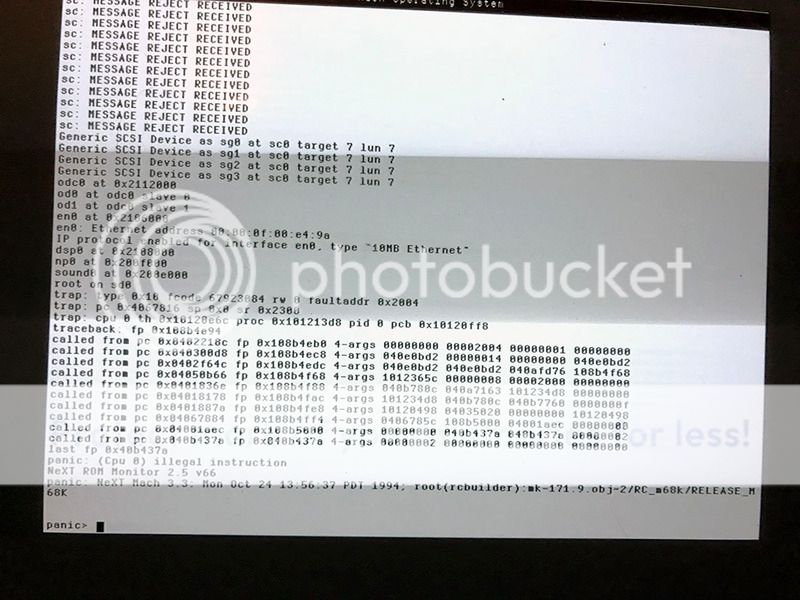
After reinstall of NS 3.3 on cube on second boot I get this. Any ideas?
 (http://s139.photobucket.com/user/NXhost/media/IMG_0827_zps5dyhju2u.jpg.html)
 (http://s139.photobucket.com/user/NXhost/media/IMG_0827_zps5dyhju2u.jpg.html)

Title: NeXTcube boot problem
Post by: barcher174 on December 20, 2016, 08:49:05 PM
Post by: barcher174 on December 20, 2016, 08:49:05 PM
Do you have a CDROM attached? If so, try removing it or any other external SCSI devices if attached.
Title: NeXTcube boot problem
Post by: scarecrow on December 21, 2016, 08:23:03 AM
Post by: scarecrow on December 21, 2016, 08:23:03 AM
No external scsi attached. Disconnected internal (Apple) cd too but same problem continues. Cube boots fine with install floppy and installs fine to hdd. then after second boot this happens every time. also boots fine with "bfd -s" could this happen because of empty pram battery or faulty capacitors?
Title: NeXTcube boot problem
Post by: bobo68 on December 21, 2016, 10:47:02 AM
Post by: bobo68 on December 21, 2016, 10:47:02 AM
Do you really have a NeXTCube (68040 CPU) or an older "NeXT Computer" cube (68030)?
Title: NeXTcube boot problem
Post by: scarecrow on December 21, 2016, 11:02:45 AM
Post by: scarecrow on December 21, 2016, 11:02:45 AM
NeXTcube Model No: N1000A Part No:2115
68040@25MHz
68040@25MHz
Title: NeXTcube boot problem
Post by: bobo68 on December 21, 2016, 11:44:20 AM
Post by: bobo68 on December 21, 2016, 11:44:20 AM
Ok. Unless somebody has seen this pattern we can only try to understand the problem bottom up / analyze what we see. Or you rip out the SCSI HD and try a different one. :-) This drive did work before you reinstalled NS 3.3? Have you activated the SCSI boot tests? Is this a 16-bit SCSI drive with some adapter?
Looking at what we see:
"sc: MESSAGE REJECT RECEIVED" comes from the SCSI bus. There is another thread here about the SCSI2SD in which people describe this symptom.
After "root on sd0" you would normally see the time & date and then how the filesystems are mounted.
A trap is the 68k way to have an exception from normal program flow. I could not find out what "trap 0x10" (16) is in the NeXT world. 16 is strange, real traps are normally numbered from 0 - 15 but who know how they used the word trap here. It might give a hint. Or we are already in some memory area with random bits and bytes and it just happens to be a trap 16.
No matter what, after the trap there is a illegal instruction which means there is binary garbage.
Not very helpful, sorry.
Looking at what we see:
"sc: MESSAGE REJECT RECEIVED" comes from the SCSI bus. There is another thread here about the SCSI2SD in which people describe this symptom.
After "root on sd0" you would normally see the time & date and then how the filesystems are mounted.
A trap is the 68k way to have an exception from normal program flow. I could not find out what "trap 0x10" (16) is in the NeXT world. 16 is strange, real traps are normally numbered from 0 - 15 but who know how they used the word trap here. It might give a hint. Or we are already in some memory area with random bits and bytes and it just happens to be a trap 16.
No matter what, after the trap there is a illegal instruction which means there is binary garbage.
Not very helpful, sorry.
Title: NeXTcube boot problem
Post by: barcher174 on December 21, 2016, 10:08:10 PM
Post by: barcher174 on December 21, 2016, 10:08:10 PM
I suspect that the "sc: MESSAGE REJECT RECEIVED" errors went away after removing the Apple CDROM. Is that correct? What model of hard drive are you using? Capacitors can never be ruled out in situations like these. I would also try another SCSI cable if available. In the file archive you will find the next hardware diagnostics. They are potentially very useful for situations like these. Particularly for testing the memory, which also is a potential source of the problem.