Title: Inside NeXT the 2024 Extended version is seeking your thoughts about NeXT
Post by: Rob Blessin Black Hole on June 01, 2024, 10:30:22 PM
Post by: Rob Blessin Black Hole on June 01, 2024, 10:30:22 PM
Hello NeXT Community: I thought you all would enjoy this and it is a 2 week deadline of June 15th.
Luciano the Author and I Rob Blessin are inviting you to give us a couple of options about your experience with NeXT over the years.
We are planning on adding a few chapters 20 to 24 pages may be more if there is room for the the 2024 edition , so we Invite you to create may be it is as simple as a statement , a story of how you used NeXT or interactions with NeXT may be even Steve Jobs stories.
I can't guarantee everyone will be included including me but I thought you all would enjoy an opportunity to write about it.
Setting parameter options
one line quote,
paragraph and or
a 1 to 2 page essay.
We already have a few very good submissions and look forward to yours.
You also will be credited as a coauthor
and if it doesn't make it into this edition, I'm confident their will be future editions of Inside NeXT.
My plan is to have a dedicated section of my blackholeinc.com website for this as well.
So with your permission , I would post them there as well.
Let the competition begin!
Also describing how you used or dreamed of NeXT software , hardware and photos welcome.
I would also invite you to post them here in this thread as it will be fun for everyone to read about sound good?
I still have copies of the 2023 Edition for sale and you can see my write up of Luciano's excellent Inside NeXT book.
Luciano will make the ultimate decisions on the additions to the 2024 extended version. I only hope my submission makes the cut and I'm starting to write it this evening.
I still have of few of the 2023 Inside NeXT books available here about 15 copies left and have been selling them at a steady rate, https://www.ebay.com/itm/285836707757
Also if you would like to get in cue to reserve a copy or copies of the 2024 edition please let us know as we may be able to add a few extra to the production of the planned run of 100.
I'm running it on a shoe string budget as usual but it is a worth while endeavor.
Anyone out there have experience being an editor , please let me know as we can use your help.
If you have ideas on this as well please let me know as it is a collaborative NeXT Community effort.
It just feels right for me to open up the submissions and set a 2 week timeline makes it fun like back in the day.
If you like this idea please comment, you don't have to participate but yes we would enjoy hearing from you.
Ready Set go...
Luciano if you are reading this I hope it makes you smile !
Luciano the Author and I Rob Blessin are inviting you to give us a couple of options about your experience with NeXT over the years.
We are planning on adding a few chapters 20 to 24 pages may be more if there is room for the the 2024 edition , so we Invite you to create may be it is as simple as a statement , a story of how you used NeXT or interactions with NeXT may be even Steve Jobs stories.
I can't guarantee everyone will be included including me but I thought you all would enjoy an opportunity to write about it.
Setting parameter options
one line quote,
paragraph and or
a 1 to 2 page essay.
We already have a few very good submissions and look forward to yours.
You also will be credited as a coauthor
and if it doesn't make it into this edition, I'm confident their will be future editions of Inside NeXT.
My plan is to have a dedicated section of my blackholeinc.com website for this as well.
So with your permission , I would post them there as well.
Let the competition begin!
Also describing how you used or dreamed of NeXT software , hardware and photos welcome.
I would also invite you to post them here in this thread as it will be fun for everyone to read about sound good?
I still have copies of the 2023 Edition for sale and you can see my write up of Luciano's excellent Inside NeXT book.
Luciano will make the ultimate decisions on the additions to the 2024 extended version. I only hope my submission makes the cut and I'm starting to write it this evening.
I still have of few of the 2023 Inside NeXT books available here about 15 copies left and have been selling them at a steady rate, https://www.ebay.com/itm/285836707757
Also if you would like to get in cue to reserve a copy or copies of the 2024 edition please let us know as we may be able to add a few extra to the production of the planned run of 100.
I'm running it on a shoe string budget as usual but it is a worth while endeavor.
Anyone out there have experience being an editor , please let me know as we can use your help.
If you have ideas on this as well please let me know as it is a collaborative NeXT Community effort.
It just feels right for me to open up the submissions and set a 2 week timeline makes it fun like back in the day.
If you like this idea please comment, you don't have to participate but yes we would enjoy hearing from you.
Ready Set go...
Luciano if you are reading this I hope it makes you smile !
Title: Re: Inside NeXT the 2024 Extended version is seeking your thoughts about NeXT
Post by: cooltr6 on June 02, 2024, 12:12:27 AM
Post by: cooltr6 on June 02, 2024, 12:12:27 AM
Rob...this is a fabulous idea and a great way to get the 'time tested' stories of people who used NeXT equipment back in the day or even the hobbyist who has taken an interest. Another bit to get the community involved. I'll help wherever I can, if needed.
Title: Re: Inside NeXT the 2024 Extended version is seeking your thoughts about NeXT
Post by: andreas_g on June 02, 2024, 02:35:25 AM
Post by: andreas_g on June 02, 2024, 02:35:25 AM
Birth of the first NeXT emulator or how an Atari turned into a NeXT Computer
It all started in the year 2001 when I installed Mac OS X 10.1 (Puma) on my first computer, an old white iBook G3. At that time I was at the age of 15 and was fascinated by that new operating system and all its capabilities. It was way superior to Mac OS 8.5, which was the operating system I used on my parents' Bondi Blue iMac G3.
I surfed the Internet using OmniWeb 4 and learned that Mac OS X had its roots in NeXTstep. I immediately loved the look of NeXTstep's user interface and wanted to see it in action. I was interested in operating system history before and already had some old Mac operating systems running in vMac. So I started looking for an emulator that would be able run NeXTstep.
Some time went past before I came across Q.app, a GUI front end for QEMU that ran on PowerPC Macs. I started experimenting with Q.app and finally succeeded installing NeXTstep 3.3 for Intel on a simulated PC. I was even able to connect NeXTstep to Internet. The instructions for doing this I got from the NeXT International Forums, a place where NeXT enthusiasts and even former NeXT employees shared their knowledge. Even though NeXTstep was running very slowly due to my host system, I still loved to be able to experience the look and feel of NeXTstep.
After a short intermezzo with an iMac G5 that soon suffered from capacitor plague I got myself an Intel iMac. This made it possible to run NeXTstep 3.3 for Intel on VMware Fusion, which was a totally new experience. For the first time I could run NeXTstep with reasonable performance. But I was not happy with the VMwareFB display driver because it had no suitable resolution for running NeXTstep full screen on my iMac. Therefore I hacked the VMwareFB driver to add more resolutions. That was my first contact with programming.
After using my virtual PC for some time I started missing the ability to run the very first version of NeXTstep and some of the platform's famous applications like Lotus Improv. These would only run on real black hardware. No emulator was out there to simulate those machines.
Short after someone on the NeXT International Forums started a discussion with the topic "What Needs to be done for a NeXT Emulator". I think at that time nobody expected this would become the longest thread on the forums. There were doubts that it would be feasibly to write such an emulator. Nevertheless Gilles Fetis, the one who already wrote the Lisa emulator IDLE, started a project. He modified Hatari, which is a great Atari emulator, to read an image of a NeXT ROM and execute some early boot routines. Work on Previous progressed on this base by replacing Atari specific parts by NeXT specific ones. This is how an Atari turned into a NeXT.
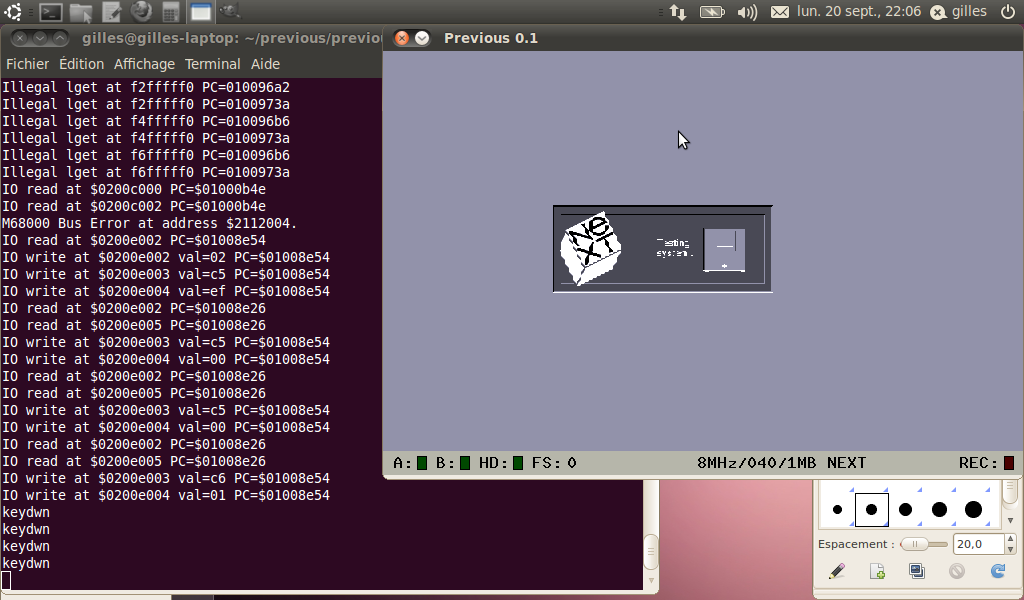
I soon joined the discussion on the forums and tried to help putting together all kind of informations to make progress on this project. After some time I started hacking on the source code myself. My intention was to add keyboard input. There was quite some studying involved as I had to learn programming in C and at the same time try to understand how a computer works on the hardware logic level. Nevertheless I succeeded in adding keyboard input. Parenthetically I got a self-taught C programmer.
With the intention to pass the power-on selftest of the ROM I was reading lots of data sheets from different parts like FPU, SCSI controller, Real Time Clock chip and so on. I tried to replicate the functionality of those parts using my beginner level programming skills. There was lots of trial and error involved in this process. Nevertheless continuous progress was possible.
As not all parts of black hardware were documented it was quite difficult to simulate things like NeXT's custom DMA controller and magneto-optical disk drive controller. This was only possible with great support from the people at the forums who provided me with values they obtained from their black hardware and all other kinds of informations they could gather. After about two years Previous passed the power-on self test but there was still lots of work to do for booting an operating system.
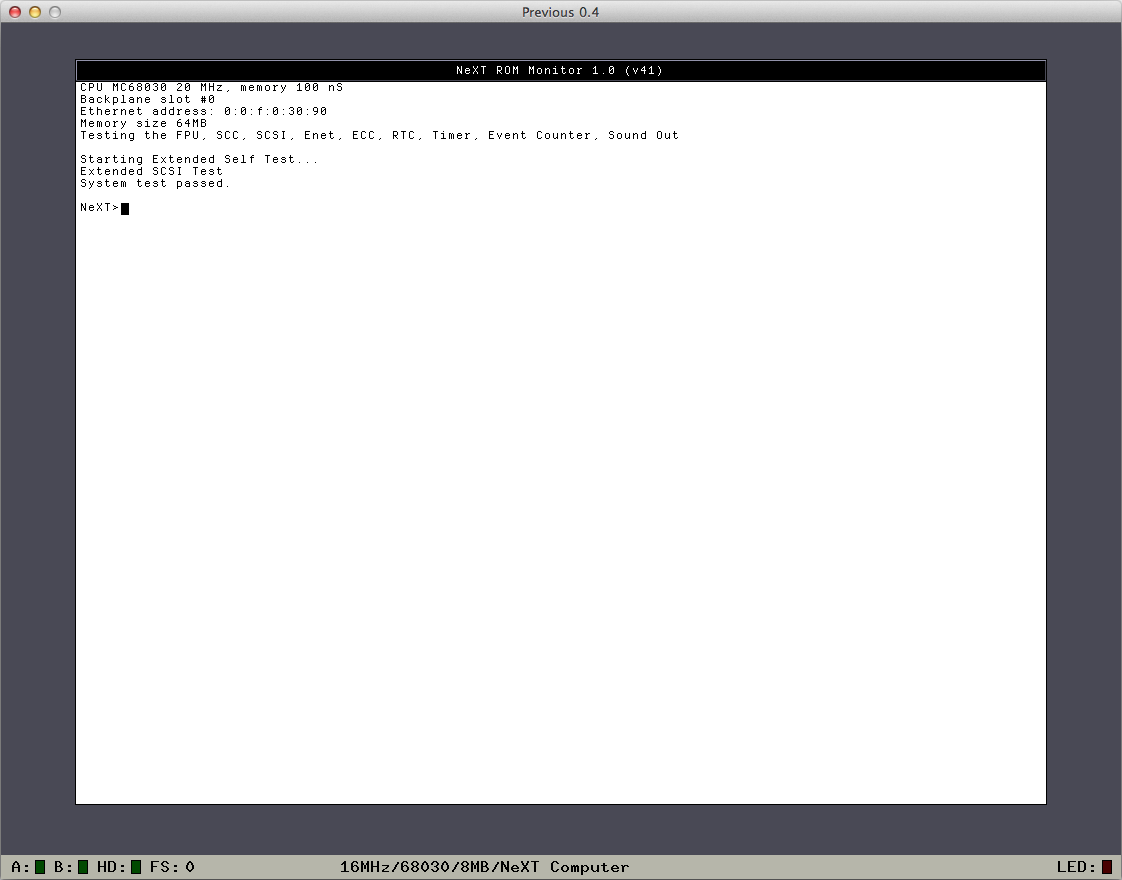
Hatari's CPU core that was derived from WinUAE lacked support for the 68030 MMU. Adding this was a project on its own but with the help of the Hatari community and the developer of WinUAE, Toni Wilen, it succeeded. One and a half year after passing the power-on test NeXTstep booted on simulated black hardware for the first time (February 20th 2014).
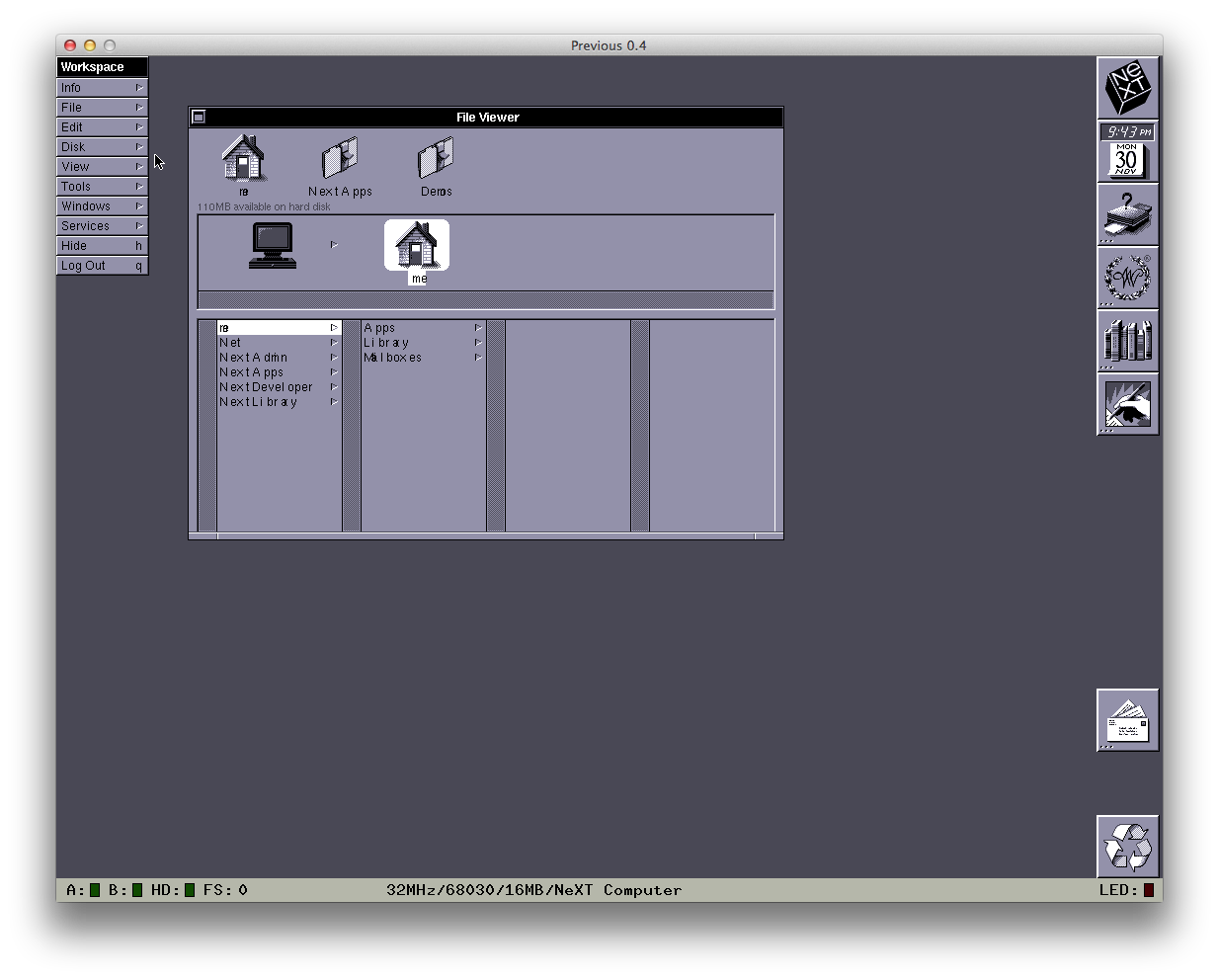
From then on I was able to pick up speed as my programming skills got better and Previous 1.0 was released about one year later (June 14th 2015). At that point it was already capable of running every version of NeXTstep/OPENSTEP from 0.8 through 4.2.
Some features got added later on. The two most remarkable additions were the simulation of the NeXTdimension graphics board and support for netbooting from a shared folder. Both of these features were added by Simon Schubiger, who was earlier involved in developing the Daydream ROM Box.
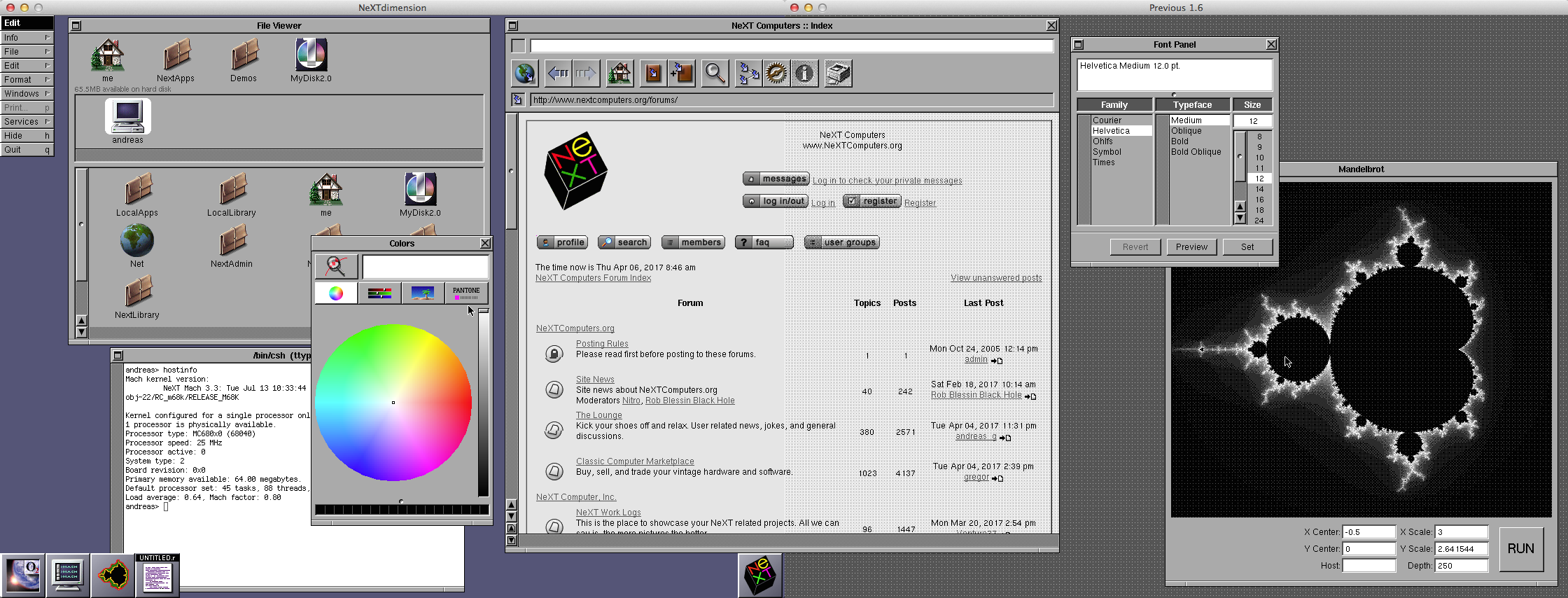
Many thanks go to the people on the NeXT International Forums for their continued support. Previous was not made by me or any other single person. It is the work of many people inside and outside the NeXT community.
Written by Andreas Grabher
It all started in the year 2001 when I installed Mac OS X 10.1 (Puma) on my first computer, an old white iBook G3. At that time I was at the age of 15 and was fascinated by that new operating system and all its capabilities. It was way superior to Mac OS 8.5, which was the operating system I used on my parents' Bondi Blue iMac G3.
I surfed the Internet using OmniWeb 4 and learned that Mac OS X had its roots in NeXTstep. I immediately loved the look of NeXTstep's user interface and wanted to see it in action. I was interested in operating system history before and already had some old Mac operating systems running in vMac. So I started looking for an emulator that would be able run NeXTstep.
Some time went past before I came across Q.app, a GUI front end for QEMU that ran on PowerPC Macs. I started experimenting with Q.app and finally succeeded installing NeXTstep 3.3 for Intel on a simulated PC. I was even able to connect NeXTstep to Internet. The instructions for doing this I got from the NeXT International Forums, a place where NeXT enthusiasts and even former NeXT employees shared their knowledge. Even though NeXTstep was running very slowly due to my host system, I still loved to be able to experience the look and feel of NeXTstep.
After a short intermezzo with an iMac G5 that soon suffered from capacitor plague I got myself an Intel iMac. This made it possible to run NeXTstep 3.3 for Intel on VMware Fusion, which was a totally new experience. For the first time I could run NeXTstep with reasonable performance. But I was not happy with the VMwareFB display driver because it had no suitable resolution for running NeXTstep full screen on my iMac. Therefore I hacked the VMwareFB driver to add more resolutions. That was my first contact with programming.
After using my virtual PC for some time I started missing the ability to run the very first version of NeXTstep and some of the platform's famous applications like Lotus Improv. These would only run on real black hardware. No emulator was out there to simulate those machines.
Short after someone on the NeXT International Forums started a discussion with the topic "What Needs to be done for a NeXT Emulator". I think at that time nobody expected this would become the longest thread on the forums. There were doubts that it would be feasibly to write such an emulator. Nevertheless Gilles Fetis, the one who already wrote the Lisa emulator IDLE, started a project. He modified Hatari, which is a great Atari emulator, to read an image of a NeXT ROM and execute some early boot routines. Work on Previous progressed on this base by replacing Atari specific parts by NeXT specific ones. This is how an Atari turned into a NeXT.
I soon joined the discussion on the forums and tried to help putting together all kind of informations to make progress on this project. After some time I started hacking on the source code myself. My intention was to add keyboard input. There was quite some studying involved as I had to learn programming in C and at the same time try to understand how a computer works on the hardware logic level. Nevertheless I succeeded in adding keyboard input. Parenthetically I got a self-taught C programmer.
With the intention to pass the power-on selftest of the ROM I was reading lots of data sheets from different parts like FPU, SCSI controller, Real Time Clock chip and so on. I tried to replicate the functionality of those parts using my beginner level programming skills. There was lots of trial and error involved in this process. Nevertheless continuous progress was possible.
As not all parts of black hardware were documented it was quite difficult to simulate things like NeXT's custom DMA controller and magneto-optical disk drive controller. This was only possible with great support from the people at the forums who provided me with values they obtained from their black hardware and all other kinds of informations they could gather. After about two years Previous passed the power-on self test but there was still lots of work to do for booting an operating system.
Hatari's CPU core that was derived from WinUAE lacked support for the 68030 MMU. Adding this was a project on its own but with the help of the Hatari community and the developer of WinUAE, Toni Wilen, it succeeded. One and a half year after passing the power-on test NeXTstep booted on simulated black hardware for the first time (February 20th 2014).
From then on I was able to pick up speed as my programming skills got better and Previous 1.0 was released about one year later (June 14th 2015). At that point it was already capable of running every version of NeXTstep/OPENSTEP from 0.8 through 4.2.
Some features got added later on. The two most remarkable additions were the simulation of the NeXTdimension graphics board and support for netbooting from a shared folder. Both of these features were added by Simon Schubiger, who was earlier involved in developing the Daydream ROM Box.
Many thanks go to the people on the NeXT International Forums for their continued support. Previous was not made by me or any other single person. It is the work of many people inside and outside the NeXT community.
Written by Andreas Grabher
Title: Re: Inside NeXT the 2024 Extended version is seeking your thoughts about NeXT
Post by: user341 on June 02, 2024, 08:53:06 AM
Post by: user341 on June 02, 2024, 08:53:06 AM
Andreas thank you so much, and all those that helped you, for creating a piece of amazing history, to preserve a piece of wonderful history!