Title: Window Maker Live 12.8 released with GNUstep integration
Post by: wmlive on December 10, 2024, 05:54:21 AM
Post by: wmlive on December 10, 2024, 05:54:21 AM
The Linux distribution Window Maker Live (https://sourceforge.net/projects/wmlive) is now available for download in version 12.8 (https://sourceforge.net/projects/wmlive/files/wmlive-bookworm-12.8/).
Window Maker Live is an installable Linux Live ISO based on the current Bookworm branch of Debian. The system uses the Window Maker window manager as the default graphical user interface. Window Maker Live's components have been carefully preconfigured and the desktop environment has a consistent visual appearance. Window Maker Live integrates selected components from other desktop environments such as XFCE4, MATE, LXQT, with a particular focus on GNUstep.
Window Maker Live can somewhat be considered a poor man's GNUstep Live DVD, although GNUstep is not the only focus of the distribution. To my knowledge there is no other Linux distribution out there that comes even close to this level of usability of GNUstep integration into the desktop. At the end of the day, the whole project aims at being a perfectly functional integrated user environment.
The former versioning scheme based on Window Maker's version number has been changed to emphasize the close relationship to the version of Debian/Bookwom on which the project is ultimately based.
What's new in this release is the much better integration of GNUstep components in their most current versions and the general expansion of the scope of the included software:
Not included are common YouTube-enabled web browsers such as Chrome/Brave/Vivaldi/Firefox/Opera/etc. or something like LibreOffice or Thunderbird and other standard programs. Instead, the web browsers PaleMoon (https://www.palemoon.org/), the Otter-Browser (https://otter-browser.org/) and for the command line lynx (https://lynx.invisible-island.net/) and links (http://links.twibright.com/) are included. For mail there are claws-mail (https://www.claws-mail.org/) and GNUMail (http://www.nongnu.org/gnustep-nonfsf/gnumail/), as well as mutt (http://www.mutt.org/) on the command line.
What is not immediately apparent from the graphical interface and has therefore been deliberately ignored in all the reviews I have seen so far is the amount and usefulness of the included command line tools. Pretty much everything you need for system administration and repairing broken systems is there. This includes all possible and impossible tools for repairing most file system variants, clonezilla, Android tools, chntpw and ntfs-3g, various partitioning tools, (de)compression programs, and much more. And of course tlp (https://linrunner.de/tlp) is also included.
With this equipment, it should certainly be possible for so inclined users to be able to do without the graphical interface entirely and, thanks to screen/tmux, mc, vim/emacs, mutt and so on, still be able to work relatively comfortably just on the console.
This description at best actually only scratches the surface and I didn't want to have to break my fingers writing. Instead of trying to get an idea based on a necessarily incomplete description, it is advisable to simply examine the downloaded ISO more closely in a VM.
This distribution is almost certainly unsuitable for users who are rather inexperienced in UNIX matters, as its handling goes beyond the usage conventions of Windows and MacOS. For normal users, it is better to use Mint, MX Linux, Ubuntu, or EndevaourOS instead, where no historically influenced UNIX rough edges are to be expected.
The ISO images are available for i386 and amd64. Unfortunately, while creating an ARM variant (arm64) is easily possible on a Pinebook Pro, the result cannot be booted on the very same Pinebook Pro due to its lack of EFI, and how to create an ISO that can be booted with u-boot is still a mystery to me. The arm64 ISO apparently works as expected in QEMU, but whether this also works on a real ARM machine is unknown. Since there is no other ARM hardware for minimal testing, an arm64 ISO of unknown quality was not provided for the time being.
If you want, you can build your own customized ISOs from the build tree source code (https://sourceforge.net/projects/wmlive/files/wmlive-bookworm-12.8/wmlive-bookworm-12.8.tar.xz) which was used to create the ISO. In any case, a Window Maker Live system installed to disk already integrates everything necessary to create its own distribution medium. Obviously, I'm fascinated by this recursion aspect.
Window Maker Live is an installable Linux Live ISO based on the current Bookworm branch of Debian. The system uses the Window Maker window manager as the default graphical user interface. Window Maker Live's components have been carefully preconfigured and the desktop environment has a consistent visual appearance. Window Maker Live integrates selected components from other desktop environments such as XFCE4, MATE, LXQT, with a particular focus on GNUstep.
Window Maker Live can somewhat be considered a poor man's GNUstep Live DVD, although GNUstep is not the only focus of the distribution. To my knowledge there is no other Linux distribution out there that comes even close to this level of usability of GNUstep integration into the desktop. At the end of the day, the whole project aims at being a perfectly functional integrated user environment.
The former versioning scheme based on Window Maker's version number has been changed to emphasize the close relationship to the version of Debian/Bookwom on which the project is ultimately based.
What's new in this release is the much better integration of GNUstep components in their most current versions and the general expansion of the scope of the included software:
- Previous (https://sourceforge.net/projects/previous/), which implements the m68k hardware of NeXT computers in software and allows the operation of the NeXTSTEP and OPENSTEP operating systems.
- 86Box (https://github.com/86Box/86Box), an emulator for x86-based PC's with support for Intel CPU's up to a maximum of Pentium II. Perfectly runs both NeXTSTEP and OPENSTEP for Intel.
- scantailor-advanced (https://github.com/ScanTailor-Advanced/scantailor-advanced), an excellent program for post-processing scanned book pages
- TeX Live (https://www.tug.org/texlive/), the internationally leading document production system for TeX and LaTeX... and so much more that you can find out better in practice.
Not included are common YouTube-enabled web browsers such as Chrome/Brave/Vivaldi/Firefox/Opera/etc. or something like LibreOffice or Thunderbird and other standard programs. Instead, the web browsers PaleMoon (https://www.palemoon.org/), the Otter-Browser (https://otter-browser.org/) and for the command line lynx (https://lynx.invisible-island.net/) and links (http://links.twibright.com/) are included. For mail there are claws-mail (https://www.claws-mail.org/) and GNUMail (http://www.nongnu.org/gnustep-nonfsf/gnumail/), as well as mutt (http://www.mutt.org/) on the command line.
What is not immediately apparent from the graphical interface and has therefore been deliberately ignored in all the reviews I have seen so far is the amount and usefulness of the included command line tools. Pretty much everything you need for system administration and repairing broken systems is there. This includes all possible and impossible tools for repairing most file system variants, clonezilla, Android tools, chntpw and ntfs-3g, various partitioning tools, (de)compression programs, and much more. And of course tlp (https://linrunner.de/tlp) is also included.
With this equipment, it should certainly be possible for so inclined users to be able to do without the graphical interface entirely and, thanks to screen/tmux, mc, vim/emacs, mutt and so on, still be able to work relatively comfortably just on the console.
This description at best actually only scratches the surface and I didn't want to have to break my fingers writing. Instead of trying to get an idea based on a necessarily incomplete description, it is advisable to simply examine the downloaded ISO more closely in a VM.
This distribution is almost certainly unsuitable for users who are rather inexperienced in UNIX matters, as its handling goes beyond the usage conventions of Windows and MacOS. For normal users, it is better to use Mint, MX Linux, Ubuntu, or EndevaourOS instead, where no historically influenced UNIX rough edges are to be expected.
The ISO images are available for i386 and amd64. Unfortunately, while creating an ARM variant (arm64) is easily possible on a Pinebook Pro, the result cannot be booted on the very same Pinebook Pro due to its lack of EFI, and how to create an ISO that can be booted with u-boot is still a mystery to me. The arm64 ISO apparently works as expected in QEMU, but whether this also works on a real ARM machine is unknown. Since there is no other ARM hardware for minimal testing, an arm64 ISO of unknown quality was not provided for the time being.
If you want, you can build your own customized ISOs from the build tree source code (https://sourceforge.net/projects/wmlive/files/wmlive-bookworm-12.8/wmlive-bookworm-12.8.tar.xz) which was used to create the ISO. In any case, a Window Maker Live system installed to disk already integrates everything necessary to create its own distribution medium. Obviously, I'm fascinated by this recursion aspect.
Title: Re: Window Maker Live 12.8 released with GNUstep integration
Post by: mikeboss on January 03, 2025, 06:00:02 AM
Post by: mikeboss on January 03, 2025, 06:00:02 AM
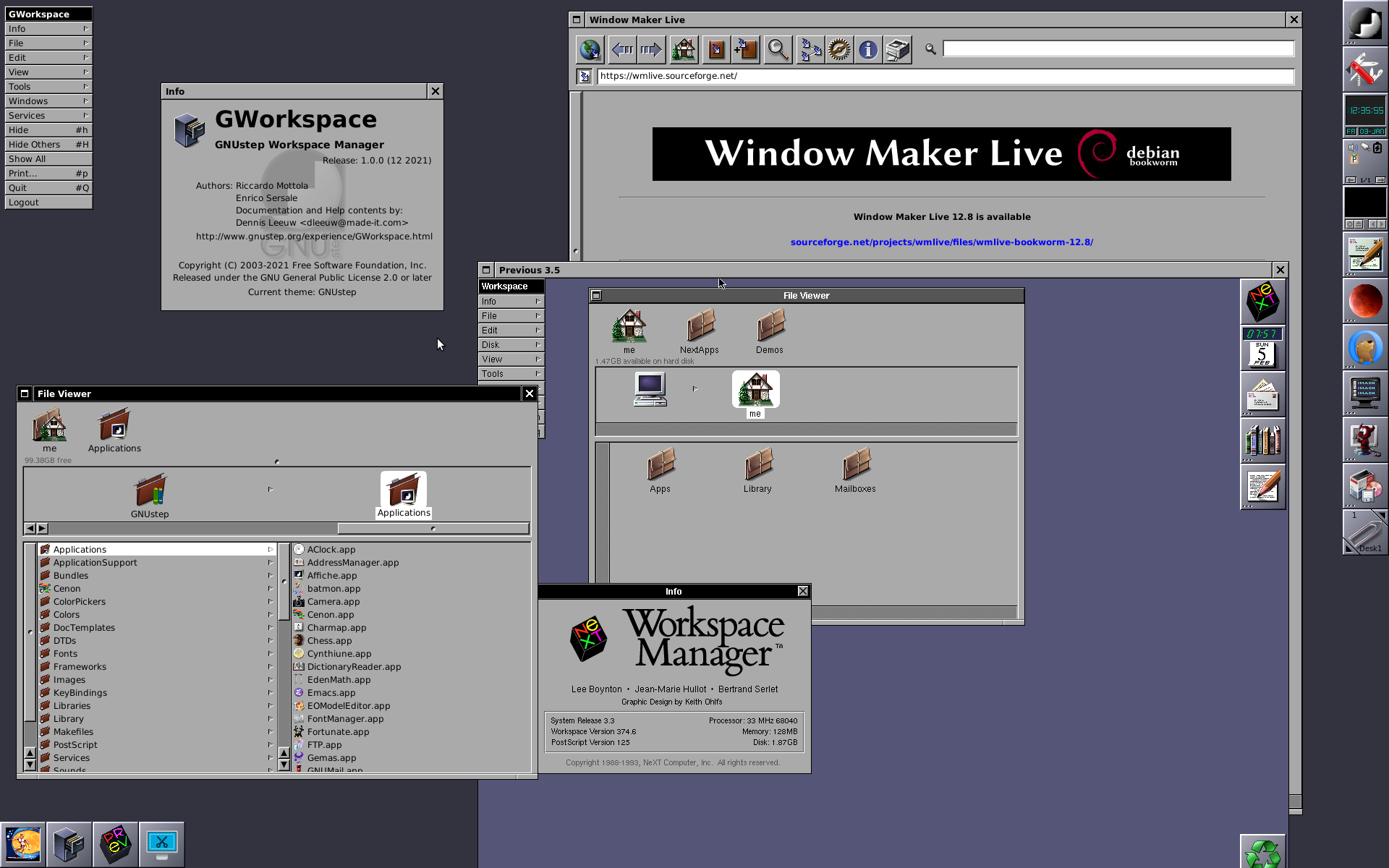
I've just installed this distro on one of my spare PCs. wow, this must be the best looking Debian I have ever seen! much love went into this, that's for sure. thnx a lot!
Title: Re: Window Maker Live 12.8 released with GNUstep integration
Post by: wizard on January 03, 2025, 02:48:11 PM
Post by: wizard on January 03, 2025, 02:48:11 PM
Is this 32bit only?
Title: Re: Window Maker Live 12.8 released with GNUstep integration
Post by: wmlive on January 03, 2025, 03:01:32 PM
Post by: wmlive on January 03, 2025, 03:01:32 PM
Quote from: wizard on January 03, 2025, 02:48:11 PMIs this 32bit only?Beginning of next to last paragraph of the introduction text says:
"The ISO images are available for i386 and amd64."
i386 = 32 bit
amd64 = 64 bit
Title: Re: Window Maker Live 12.8 released with GNUstep integration
Post by: pTeK on January 06, 2025, 02:35:36 AM
Post by: pTeK on January 06, 2025, 02:35:36 AM
Quote from: wmlive on December 10, 2024, 05:54:21 AMWhat is not immediately apparent from the graphical interface and has therefore been deliberately ignored in all the reviews I have seen so far is the amount and usefulness of the included command line tools. Pretty much everything you need for system administration and repairing broken systems is there. This includes all possible and impossible tools for repairing most file system variants, clonezilla, Android tools, chntpw and ntfs-3g, various partitioning tools, (de)compression programs, and much more. And of course tlp (https://linrunner.de/tlp) is also included.Does this come with any CD/DVD burning software on it to burn ISOs? I can't access my Windows XP Partition which had Nero on it which is what I used to use to burn CDs.
Title: Re: Window Maker Live 12.8 released with GNUstep integration
Post by: wmlive on January 06, 2025, 09:51:40 AM
Post by: wmlive on January 06, 2025, 09:51:40 AM
Quote from: pTeK on January 06, 2025, 02:35:36 AMDoes this come with any CD/DVD burning software on it to burn ISOs?Yes, it includes both xfburn in version 0.7.0 (https://docs.xfce.org/apps/xfburn/start) and growisofs (https://manpages.debian.org/bookworm/growisofs/growisofs.1.en.html).
A full listing of the included software can be found in the *.list files available at the sourceforge download page. After installation, any additional software can always be easily installed using the Debian apt package management tools.
While burning it to DVD is an option, the recommended way to use the wmlive ISO image is to cat/dd it to a USB pendrive instead, as described in the accompanying README.txt. For Windows users, the ISO images include the rufus utility to create bootable USB drives (https://rufus.ie/en/) in its tools subfolder.
Title: Re: Window Maker Live 12.8 released with GNUstep integration
Post by: pTeK on January 06, 2025, 12:07:12 PM
Post by: pTeK on January 06, 2025, 12:07:12 PM
Quote from: wmlive on January 06, 2025, 09:51:40 AMYes, it includes both xfburn in version 0.7.0 (https://docs.xfce.org/apps/xfburn/start) and growisofs (https://manpages.debian.org/bookworm/growisofs/growisofs.1.en.html).Thanks for this will give it a go after work, I need to burn some CDs and as I no longer have windows XP working I've been looking for an alternative, this should do nicely :)
Quote from: wmlive on January 06, 2025, 09:51:40 AMWhile burning it to DVD is an option, the recommended way to use the wmlive ISO image is to cat/dd it to a USB pendrive instead, as described in the accompanying README.txt. For Windows users, the ISO images include the rufus utility to create bootable USB drives (https://rufus.ie/en/) in its tools subfolder.
Was going to use a USB stick, the laptop has a USB2.0 slot which although slow compared to USB3.0 it's faster than USB 1.1. Those USB 1.1 speeds :'( was OK back in 2002 for copying files from computer instead of having to walk around with blank CDs.
Title: Re: Window Maker Live 12.8 released with GNUstep integration
Post by: pTeK on January 18, 2025, 02:00:53 AM
Post by: pTeK on January 18, 2025, 02:00:53 AM
Quote from: wmlive on January 06, 2025, 09:51:40 AMYes, it includes both xfburn in version 0.7.0 (https://docs.xfce.org/apps/xfburn/start) and growisofs (https://manpages.debian.org/bookworm/growisofs/growisofs.1.en.html).
Ok so xfburn and growisofs I had trouble writing a .iso to a CD on the IBM Thinkpad 43.
I was able to write a .iso with xfburn on the Dell Inspiron 5150 (2003).
The .iso was a CD with a 2.88mb Nextstep floppy disk driver image created with Virtual Box at the front which contained EIDE driver (3.35) and EOF 1.1 files and some other NeXT files. The CD worked successfully booting and selecting drivers.
Just need to find the VESA memory addresses for the Video frame buffer to modify the VBox video driver to run on the IBM think PAD. I see they are printed in the dmesg though :).
Great work with the image.