Title: 50MHz NeXT Accelerators
Post by: Nitro on April 30, 2025, 10:05:54 PM
Post by: Nitro on April 30, 2025, 10:05:54 PM
It's nice to see that we have some NeXT accelerators on the horizon. A kind forum member sent me a link to zigzagjoe's project on 68KMLA. He's doing some really cool work on his accelerator so check it out. You can read about it here in the forums as well.
I've been working on an accelerator too, and it's nice to see that I'm not alone. I set out to build a board as a means to learn and have fun with vintage computers. There may be better, cheaper or easier ways to do this, but I'm having fun with it. To answer your question Joe, it's a new clock doubler design. I'm just a hobbyist so this is at the edge of my skill set.
I'll make a small run of these boards and see if I can make them available for those that want to try it out. Hopefully it won't cost an arm and a leg to get them made. I have three Turbo Color Slabs that I've been benchmarking at 50MHz for a few months now. I'll have more details, pictures and benchmarks when the boards are ready.
I've been working on an accelerator too, and it's nice to see that I'm not alone. I set out to build a board as a means to learn and have fun with vintage computers. There may be better, cheaper or easier ways to do this, but I'm having fun with it. To answer your question Joe, it's a new clock doubler design. I'm just a hobbyist so this is at the edge of my skill set.
I'll make a small run of these boards and see if I can make them available for those that want to try it out. Hopefully it won't cost an arm and a leg to get them made. I have three Turbo Color Slabs that I've been benchmarking at 50MHz for a few months now. I'll have more details, pictures and benchmarks when the boards are ready.
Title: Re: 50MHz NeXT Accelerators
Post by: barcher174 on April 30, 2025, 10:46:44 PM
Post by: barcher174 on April 30, 2025, 10:46:44 PM
Awesome! I'm definitely interested in trying it!
Title: Re: 50MHz NeXT Accelerators
Post by: zigzagjoe on April 30, 2025, 10:48:36 PM
Post by: zigzagjoe on April 30, 2025, 10:48:36 PM
I'm curious the approach you're taking... a drop-in clock doubler module like the vintage boards, or bclk overclocking ala this thread (https://www.nextcomputers.org/forums/index.php?topic=56)? I could see sticking a PLL on a daughterboard and bypassing/augmenting the PLL on the LB being a viable approach; splice in new clocks at the series termination resistors. An involved modification, for sure, but would also work. Truthfully, I think there's a chance you could decouple the BCLK/PCLK entirely from the LB PLL.
Or did you take a vintage design and reverse engineer it?
My design is a drop-in upgrade as I'd prefer to not make modifications to the logic board. So this means a CPU running internally at 50mhz but running on a 25mhz bus as if it were a 25mhz CPU. Good improvement to CPU performance as an 040 spends much of its time running in caches, but video/disk/IO remains the same as BCLK hasn't changed.
It has ancestry in a reverse engineered Macintosh accelerator, but I redesigned it entirely to improve performance and implement the multiplexed bus mode required to talk to NeXT LB. At this point, nothing of the original is left...
Prototype pictures are always welcome :)
Or did you take a vintage design and reverse engineer it?
My design is a drop-in upgrade as I'd prefer to not make modifications to the logic board. So this means a CPU running internally at 50mhz but running on a 25mhz bus as if it were a 25mhz CPU. Good improvement to CPU performance as an 040 spends much of its time running in caches, but video/disk/IO remains the same as BCLK hasn't changed.
It has ancestry in a reverse engineered Macintosh accelerator, but I redesigned it entirely to improve performance and implement the multiplexed bus mode required to talk to NeXT LB. At this point, nothing of the original is left...
Prototype pictures are always welcome :)
Title: Re: 50MHz NeXT Accelerators
Post by: gtnicol on May 01, 2025, 01:20:22 AM
Post by: gtnicol on May 01, 2025, 01:20:22 AM
Quote from: Nitro on April 30, 2025, 10:05:54 PMIt's nice to see that we have some NeXT accelerators on the horizon. A kind forum member sent me a link to zigzagjoe's project on 68KMLA. He's doing some really cool work on his accelerator so check it out. You can read about it here in the forums as well.
I've been working on an accelerator too, and it's nice to see that I'm not alone. I set out to build a board as a means to learn and have fun with vintage computers. There may be better, cheaper or easier ways to do this, but I'm having fun with it. To answer your question Joe, it's a new clock doubler design. I'm just a hobbyist so this is at the edge of my skill set.
I'll make a small run of these boards and see if I can make them available for those that want to try it out. Hopefully it won't cost an arm and a leg to get them made. I have three Turbo Color Slabs that I've been benchmarking at 50MHz for a few months now. I'll have more details, pictures and benchmarks when the boards are ready.
Count me in!
Title: Re: 50MHz NeXT Accelerators
Post by: trixster on May 01, 2025, 08:13:23 AM
Post by: trixster on May 01, 2025, 08:13:23 AM
I would absolutely love to try out an accelerator board for my cube!
Title: Re: 50MHz NeXT Accelerators
Post by: Nitro on May 01, 2025, 08:22:50 PM
Post by: Nitro on May 01, 2025, 08:22:50 PM
Quote from: zigzagjoe on April 30, 2025, 10:48:36 PMI'm curious the approach you're taking... a drop-in clock doubler module like the vintage boards, or bclk overclocking ala this thread (https://www.nextcomputers.org/forums/index.php?topic=56)? I could see sticking a PLL on a daughterboard and bypassing/augmenting the PLL on the LB being a viable approach; splice in new clocks at the series termination resistors. An involved modification, for sure, but would also work. Truthfully, I think there's a chance you could decouple the BCLK/PCLK entirely from the LB PLL.
Or did you take a vintage design and reverse engineer it?
My design is a drop-in upgrade as I'd prefer to not make modifications to the logic board. So this means a CPU running internally at 50mhz but running on a 25mhz bus as if it were a 25mhz CPU. Good improvement to CPU performance as an 040 spends much of its time running in caches, but video/disk/IO remains the same as BCLK hasn't changed.
It has ancestry in a reverse engineered Macintosh accelerator, but I redesigned it entirely to improve performance and implement the multiplexed bus mode required to talk to NeXT LB. At this point, nothing of the original is left...
Prototype pictures are always welcome :)
I'm working hard to get the boards made and tested so that I can release the all of the pictures, features and specifications at once. The final PCBs are ready to order. The last time it took about a week for the boards to get here but I don't know if the tariffs will affect that. I'll have all of the details after I've had a chance to test everything. I'll post pictures of the prototype too. It's a simple design just to have fun with.
I really like the design that you've created; that's NeXT level. One of the test machines that I'm using has a 40MHz 68040 that came out of a Mac accelerator from Spectrum Engineering. I was surprised to see that they used a number of bodge wires on the accelerator. Cool stuff.
Title: Re: 50MHz NeXT Accelerators
Post by: trixster on May 03, 2025, 02:11:38 PM
Post by: trixster on May 03, 2025, 02:11:38 PM
@Nitro is there any prospect of a next accelerator having its own ram, similar to how the Amiga accelerators work? On an A3000 or A4000 (or indeed something like an Atari Falcon) the accelerator card will have local fast ram for the cpu to use meaning it does not have to access motherboard ram (unless local ram is full), which is significantly slower, thereby side-stepping a huge performance bottleneck. Can the next architecture operate similarly?
Title: Re: 50MHz NeXT Accelerators
Post by: Nitro on May 03, 2025, 03:25:38 PM
Post by: Nitro on May 03, 2025, 03:25:38 PM
I'm relatively new to working on accelerators and I don't have any experience with the Amiga unfortunately. Zigzagjoe has a lot of experience so he would be better equipped to answer your question. I'm still learning so I would be interested in the answer as well.
Title: Re: 50MHz NeXT Accelerators
Post by: Rob Blessin Black Hole on May 05, 2025, 12:33:31 AM
Post by: Rob Blessin Black Hole on May 05, 2025, 12:33:31 AM
Hello NeXT Community: Wow I'm amazed 50Mhz Awesome May the 4th be with you indeed :)
I want try and buy and resell it all this is way to cool.
Now I need to go back and a. It is amazing when they work. bsorb this news, I'm in shock.
I'm dialing in the new H2D printer and in experimenting with different filaments jammed up with filament, apparently this has become an issue with the printers as Early adopters we are Beta Testing for Bambu . I'm printing and creating much needed parts for the NeXT and testing out the stl files . I'll create a thread with the 3d printed Cube backs turned out amazing.
I want try and buy and resell it all this is way to cool.
Now I need to go back and a. It is amazing when they work. bsorb this news, I'm in shock.
I'm dialing in the new H2D printer and in experimenting with different filaments jammed up with filament, apparently this has become an issue with the printers as Early adopters we are Beta Testing for Bambu . I'm printing and creating much needed parts for the NeXT and testing out the stl files . I'll create a thread with the 3d printed Cube backs turned out amazing.
Title: Re: 50MHz NeXT Accelerators
Post by: Nitro on May 11, 2025, 02:12:15 PM
Post by: Nitro on May 11, 2025, 02:12:15 PM
Just a quick update; I'm still waiting on the tariff situation to be resolved so that I can order the boards at a reasonable cost.
Title: Re: 50MHz NeXT Accelerators
Post by: Nitro on May 21, 2025, 10:46:09 PM
Post by: Nitro on May 21, 2025, 10:46:09 PM
The boards are on order along with all of the parts. I have my work cut out for me.
Title: Re: 50MHz NeXT Accelerators
Post by: Nitro on May 30, 2025, 08:57:26 PM
Post by: Nitro on May 30, 2025, 08:57:26 PM
It's been a month since I started this thread so I guess it's time to get things rolling. Back around 2003 forum member Gary (@gborgns) designed a 50MHz Turbo Color accelerator. He did a fantastic job of creating and documenting his prototype project. If you haven't seen his thread you can check it out here (https://www.nextcomputers.org/forums/index.php?topic=56) along with more information here (https://www.nextcomputers.org/forums/index.php?topic=2223).
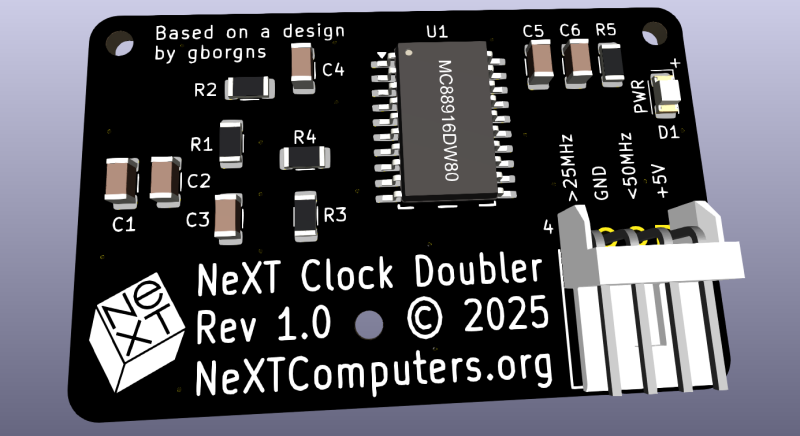
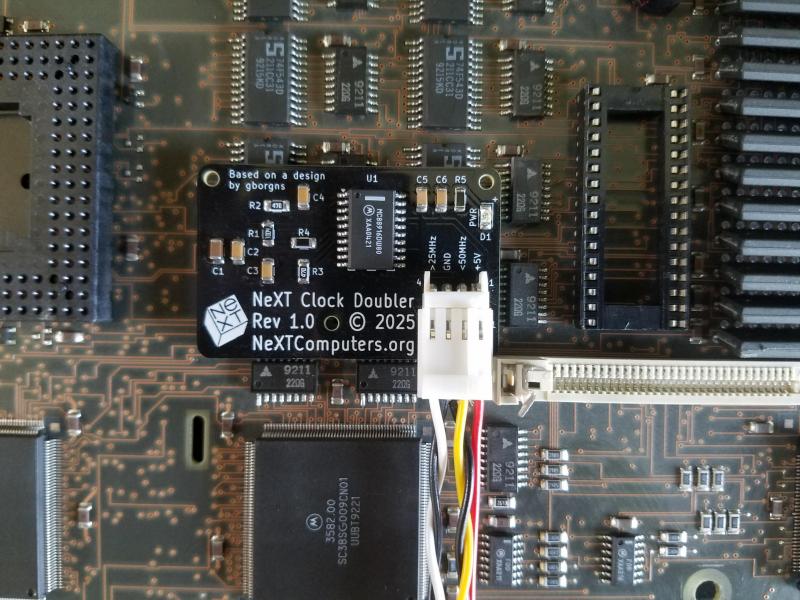
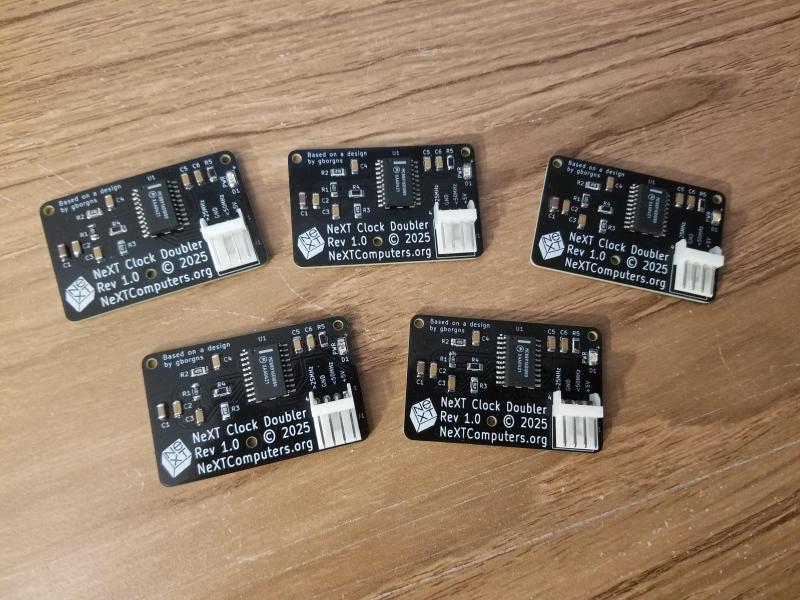
My idea with this project was to create a printed circuit board (PCB) to replace the prototype Surfboard that Gary used. His design was based on the Motorola MC88916 Clock Driver. Since the schematic for his board was from the MC88916 datasheet it was straightforward to layout a new PCB. The only change made to the circuit was to add a power LED and inline resistor. The wires connecting the PCB to the NeXT motherboard are routed through a Berg style connector. Here are some pictures of what I came up with.
There are a number of minor issues with this design. For starters, it uses prototype wires to connect to the NeXT logic board, which is less than ideal. There's also no convenient way to mount the PCB. In addition, the design is not very versatile. All that being said, it's been a fun project to work on.
Although the previously mentioned issues can be addressed, the design has one issue that can't be fixed. The accelerator is based on the MC88916 clock driver which was declared "End of Life" many years ago. The chip is not readily available in quantity and the design has an excessive amount of passive components. The good news is, the board that you see above is not the accelerator PCB that I just had manufactured for release. Partway through the design of this PCB I decided to start working concurrently on a new design from scratch with a modern clock doubler. I'll start a new thread for that project shortly.
Note to self; when adding component footprints for hand soldering don't use the smaller solder pad footprints made for pick-and-place machines.
My idea with this project was to create a printed circuit board (PCB) to replace the prototype Surfboard that Gary used. His design was based on the Motorola MC88916 Clock Driver. Since the schematic for his board was from the MC88916 datasheet it was straightforward to layout a new PCB. The only change made to the circuit was to add a power LED and inline resistor. The wires connecting the PCB to the NeXT motherboard are routed through a Berg style connector. Here are some pictures of what I came up with.
There are a number of minor issues with this design. For starters, it uses prototype wires to connect to the NeXT logic board, which is less than ideal. There's also no convenient way to mount the PCB. In addition, the design is not very versatile. All that being said, it's been a fun project to work on.
Although the previously mentioned issues can be addressed, the design has one issue that can't be fixed. The accelerator is based on the MC88916 clock driver which was declared "End of Life" many years ago. The chip is not readily available in quantity and the design has an excessive amount of passive components. The good news is, the board that you see above is not the accelerator PCB that I just had manufactured for release. Partway through the design of this PCB I decided to start working concurrently on a new design from scratch with a modern clock doubler. I'll start a new thread for that project shortly.
Note to self; when adding component footprints for hand soldering don't use the smaller solder pad footprints made for pick-and-place machines.